Urenco to Boost U.S. Uranium Enrichment Capacity by Nearly 50%
By Charles Kennedy - Jun 02, 2026,
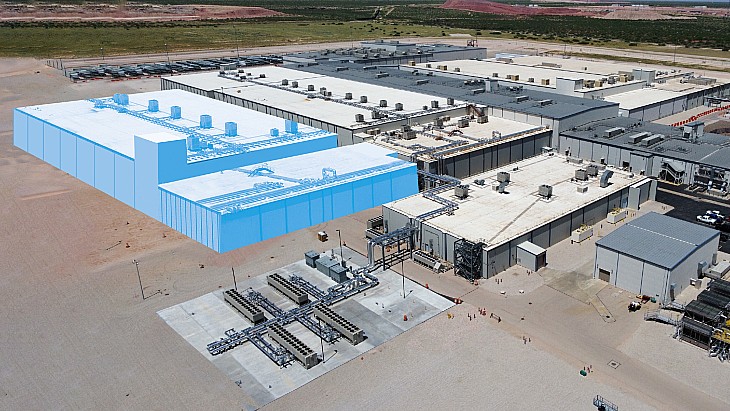
Urenco USA has announced plans for a major expansion of the National Enrichment Facility in Eunice, New Mexico, committing a multi-billion-dollar investment to increase uranium enrichment capacity by nearly 50% and reinforce the U.S. nuclear fuel supply chain.
The project will add 2.1 million separative work units (SWU) of enrichment capacity through the installation of up to 24 new centrifuge cascades using the company's gas centrifuge technology. Initial production from the expansion is expected to begin in 2032, with additional cascades coming online through 2036.
The expansion comes as the United States seeks to strengthen domestic nuclear fuel capabilities amid growing interest in both existing nuclear generation and next-generation reactor technologies. Low-enriched uranium (LEU), the primary product of the facility, fuels the current U.S. commercial reactor fleet, which generates roughly one-fifth of the nation's electricity. LEU is also a key feedstock for producing high-assay low-enriched uranium (HALEU), a fuel expected to be required by many advanced reactor designs planned for deployment in the next decade.
Urenco currently operates the only commercial-scale uranium enrichment facility in the United States. The plant's existing capacity stands at 4.3 million SWU annually, equivalent to about one-third of current U.S. enrichment demand. An ongoing expansion project adding another 700,000 SWU is scheduled for completion in 2027, while refurbishment work on existing capacity is also planned. Combined with the newly announced investment, the facility's installed capacity is expected to exceed 7 million SWU over the next decade.
The project is expected to support between 300 and 600 construction jobs at peak activity and create approximately 70 permanent operational positions. Urenco USA already employs more than 500 workers and contractors at the site, which has been operating commercially since 2010.
The New Mexico expansion forms part of a broader strategy by Urenco Global to add 4.6 million SWU of enrichment capacity across facilities in the United States, the Netherlands, and Germany. The move reflects a wider effort among Western nations to reduce dependence on Russian nuclear fuel services and build more resilient supply chains as governments increasingly view nuclear power as a key component of energy security and decarbonization strategies.
Urenco said customer commitments through new long-term contracts helped support the investment decision, underscoring growing demand for domestic enrichment services from U.S. utilities.
Antares valide la criticité d’un micro-réacteur au sodium aux États-Unis
AFP avec Connaissance des Énergies le 5 juin 2026
La start-up Antares a mené au fonctionnement autonome son prototype de micro-réacteur nucléaire aux États-Unis, une première.
Un jalon atteint à l’Idaho National Laboratory
Selon un communiqué diffusé le 4 juin, le modèle d’essai Mark-0 a atteint la criticité, c’est-à-dire une réaction de fission auto-entretenue. La démonstration a eu lieu à l’Idaho National Laboratory (Idaho Falls), Antares étant le premier lauréat du Reactor Pilot Program à franchir ce cap. Une fois ce stade atteint, le réacteur est en mesure de produire sa propre énergie en continu.
Le Mark-0 relève d’un essai de criticité à très basse puissance destiné à valider la physique du cœur, selon la documentation du ministère de l’Énergie (DOE). Le prototype s’inscrit parmi onze projets de micro-réacteurs ou SMR sélectionnés par le DOE, qui vise au moins trois criticités d’ici au 4 juillet 2026, d’après le programme fédéral annoncé en 2025.
La filière sodium
Le Mark-0 n’utilise pas l’eau pressurisée mais un caloporteur sodium. Dans cette architecture, le sodium liquide évacue la chaleur du cœur par des dispositifs passifs, une filière explorée depuis les années 1950 dans des versions de grande taille et aujourd’hui miniaturisée. Fonctionnant à pression atmosphérique, ces systèmes écartent les risques de surpression et d’explosion de vapeur caractéristiques d’accidents de type RBMK.
Le sodium impose toutefois des précautions spécifiques, s’enflammant au contact de l’air et réagissant violemment avec l’eau. Antares indique recourir à des dispositifs et procédures adaptés pour la mise en œuvre et la maintenance de ce caloporteur.
Perspectives de déploiement
Le Mark-0 a été retenu en août 2025 par le DOE au sein du Reactor Pilot Program. « Nous sommes passés d’un concept à la criticité en moins de 12 mois », s'est félicité le directeur général d’Antares, Jordan Bramble.
Antares projette la mise en service de petits réacteurs sur des sites militaires américains d’ici septembre 2028. À ce stade, l’exploitation du démonstrateur relève d’une autorisation spécifique du DOE ; une commercialisation exigera une homologation par la Commission de régulation nucléaire (NRC). À ce jour, le seul schéma SMR disposant d’une certification de conception est celui de NuScale, rappelle la NRC.
L'état de New-York cherche à faire construire au moins 1 GW de nucléaire :
New York issues solicitations for nuclear new-build
2 June 2026
The New York Power Authority has issued a call for nuclear developers and delivery partners for its initiative to develop at least 1 GW of advanced nuclear energy in Upstate New York, and an invitation to training providers to apply for USD40 million in nuclear workforce development funding.
The Request for Qualifications (RFQ) follows on from Requests for Information issued by the authority last year, to which more than 30 entities - including 23 potential developers or partners and eight Upstate New York communities - responded. It aims to identify a set of developers qualified to deliver an advanced nuclear generation project across two possible technology pathways: a large-scale reactor, "such as the AP1000" and/or a small modular reactor "such as the BWRX-300".
Respondents are asked to present "credible pathways" to deliver at least 1 GW of advanced nuclear capacity in Upstate New York, including technology readiness, siting and permitting strategy, schedule and cost assumptions, ownership structures, and partnership models. Qualified firms will then be invited to participate in a future Request for Proposal.
The authority said it would consider so-called nth-of-a-kind Generation III+ or Generation IV technologies provided that a first-of-a-kind project (either by the respondent or by another owner/developer) is "at or beyond First Nuclear Concrete by early 2030". The selected pathway must "demonstrate a credible path to both produce 1+ GW of energy and start construction before 2033" to ensure eligibility for investment tax credits under the US Inflation Reduction Act Investment Tax Credit. First-of-a-kind technologies and micro modular reactors are outside the scope of this project. Bidders must have "commensurate experience".
The deadline for submissions is 26 June.
...........................
Trés bons chiffres de production d'uranium pour Energy Fuels pour le premier semestre :
Energy Fuels expects to hit 2026 uranium guidance by midyear
Staff Writer | June 11, 2026
Energy Fuels is expected to meet its 2026 uranium production guidance at just the halfway point of the year, coinciding with the completion of ore processing at its White Mesa Mill in Utah.
In an operational update on Thursday, the Colorado-based company forecasted its uranium oxide (U3O8) production to reach 1.6 million lb. by the end of June. This figure would fall within its previously published full-year guidance range of 1.5-2.5 million lb.
“Our uranium segment continues to differentiate Energy Fuels as the clear leading US uranium producer through our strong operating performance, production and costs,” CEO Ross Bhappu said in a press release.
Shares of Energy Fuels rose 4.5% on the update, sending the company’s market capitalization in New York to $3.6 billion. Year to date, the stock is down about 13%, trading at about half of its record high set in January.
Improving grades, costs
On average, Energy Fuels said it expects to produce more than 265,000 lb. a month of finished uranium from White Mesa — currently the only fully licensed and operating conventional uranium mill in the US. The ores would be provided from the company’s two mines in the country: the Pinyon Plain in Arizona and the La Sal Complex in Utah.
................................
EnCore OK’d to build South Dakota’s first ISR uranium mine
By Blair McBride June 19, 2026
After more than a decade of local opposition, EnCore Energy (Nasdaq: EU; TSXV: EU) has received federal approval to start building its Dewey Burdock project in southwest South Dakota, advancing what would become the state’s first in-situ recovery (ISR) uranium mine.
The Bureau of Land Management (BLM) this week authorized enCore subsidiary Powertech to start construction of initial infrastructure such as access roads, monitoring wells and power lines on 97 hectares of BLM-managed public land, enCore said Thursday. Dewey Burdock, located in the historical uranium mining district of Edgemont, is about 300 km northeast of state capital Pierre.
“Securing the BLM’s approval to commence construction on BLM lands marks a significant milestone[cc1] for the Dewey Burdock Project,” enCore Executive Chair William H. Sheriff said in a release.”
“Our team’s efforts at the federal level to coordinate permitting within the Fast 41 program have greatly enhanced enCore’s ability to move forward,” Sherriff said, citing the U.S. government initiative [cc2] that last August added Dewey Burdock to its list of projects for accelerated permit reviews.
US uranium drive
EnCore’s construction step marks one of the most significant federal uranium project authorizations in the United States this year, amid a wider push to develop more domestic uranium capacity. While the state’s Edgemont district has had open pit and underground uranium mines in the past, enCore would pioneer ISR mining in South Dakota. With ISR mining, a solution is injected underground through wells, separating uranium from ore. Uranium is later recovered from the solution in a surface facility.
It also comes after more than a decade of permit reviews and legal challenges from environmental and Indigenous groups that paused Dewey Burdock’s progress. [cc3] The Nuclear Regulatory Commission granted Dewey Burdock’s ISR licence in 2014, which authorized construction and operation of the project.
The Environmental Protection Agency last September waived a petition by the Oglala Sioux Tribe, Black Hills Clean Water Alliance and NDN Collective who had challenged the project’s permits.
28-year life
Dewey Burdock hosts 17.1 million measured and indicated lb. of uranium grading 0.12% uranium oxide (U₃O₈) and 712,600 inferred lb. at 0.06% U₃O₈, according to a 2024 resource. Dewey Burdock is expected to process 1 million lb. of uranium per year, recovering more than 14 million lb. over its 28-year life.
Discounted at 8%, the project has a post-tax net present value of $133.6 million, a post-tax internal rate of return of 33% and initial capital costs of $264.2 million, according to a 2025 preliminary economic assessment.
Neighbouring Wyoming has emerged as the U.S.’ dominant uranium output jurisdiction, with the state hosting most of the country’s producing ISR uranium mines.
EnCore’s currently producing ISR operations include Rosita and Alta Mesa in Texas.
Nuclear power plant developer Elementl Power has signed an Early Works Agreement with GE Vernova Hitachi Nuclear Energy to use its BWRX-300 small modular reactors for a proposed project in Meigs County, in southeast Ohio in the USA.
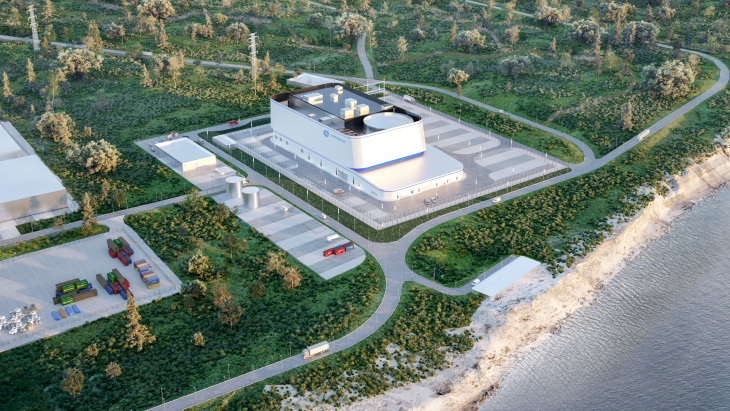
A rendering of a BWRX-300 power plant (Image: GE Vernova)
Elementl has already agreed to purchase the 700-acre site 100 miles southeast of Columbus and has filed a request with PJM Interconnection to connect the site into the regional transmission system for the first 600 MW of output.
The company says its plan is for the proposed plant to have a capacity of 1.5 GW - the equivalent of five of the BWRX-300 small modular reactors (SMRs). Elementl, which says the plant would be privately financed, says that if it goes ahead with the project, it is aiming for construction to begin in 2030 with completion of the first unit in 2034.
Elementl Chairman and CEO Chris Colbert said: "Elementl builds partnerships to accelerate the financing and delivery of reliable, clean, around-the-clock nuclear power, and we're committed to working closely with Letart Township, Meigs County, the state of Ohio and beyond throughout this process. GE Vernova Hitachi is a proven, global leader in nuclear technology, and we're pleased to partner with them to deploy their advanced BWRX-300 reactor at this site. Nuclear projects are substantial economic anchors for their communities, and with a proud industrial legacy, southeast Ohio brings the foundation and workforce needed for a project of this magnitude."
GE Vernova CEO Scott Strazik said: "We are pleased to support Elementl Power as it advances development of this project, and to work alongside customers who are taking meaningful steps to bring new nuclear generation online. Nuclear energy will play an essential part of the future energy mix and projects like this will strengthen the foundation for long-term energy security, economic growth, and reliable electricity generation in the United States."
Director of Meigs County Economic Development Office Chase Jenkins said: "Meigs County recognises the significant opportunity that Elementl's proposed project represents for our region's long-term energy future. We support continued exploration of this development and look forward to engaging with the community, state leaders, and project partners as plans take shape."
Un coup de pouce à 17,5 milliards de dollars : les Etats-Unis débloquent un prêt massif pour accélérer la construction de dix réacteurs nucléaires Westinghouse
Philippe Coste le 25 juin 2026
Ces derniers temps, il semblait plus préoccupé par le pétrole. Mais Donald Trump mise plus que jamais sa postérité sur la renaissance du nucléaire. En témoigne l’annonce spectaculaire par son département de l’Energie, mardi 23 juin, de 17,5 milliards de dollars de prêts à taux préférentiels destinés aux compagnies d’électricité américaines désireuses de s’équiper en centrales nucléaires ...
Production of uranium from mines in the USA last year was more than double 2024's figure, and the highest in nine years, according to the latest report of annual data from the Energy Information Administration.
US mines produced 1,388,000 pounds U3O8 (534 tU) in 2025, up from 677,000 pounds U3O8 in 2024. The 2025 figure was the highest since 2016's production of 2,545,000 pounds, according to the government agency's Domestic Uranium Production Report, released on 23 June. Production was from one underground mine and seven in-situ recovery operations - the same as in 2024 - with some production from "other sources" of uranium, which the Energy Information Administration (EIA) says could include mine water, mill site cleanup and mill tailings, and well field restoration.
Uranium exploration and development drilling activities in 2025 were at their highest levels since 2013 for number of holes drilled and for total footage drilled, the EIA reported. Although at the end of 2025 only one conventional uranium mill - Energy Fuels' White Mesa Mill in Utah - was in operation, two remained on standby (the Shootaring Canyon Uranium Mill in Utah and the Sweetwater Uranium Project in Wyoming), while the Sheep Mountain heap leach facility in Wyoming had reached a partial permitting and licensed stage.
In-situ recovery (ISR) facilities at the Alta Mesa, Lost Creek, Smith Ranch-Highland Operation, Ross Central Processing, and Willow Creek projects were operating at the end of the year, with a combined annual capacity of 13.3 million pounds U3O8 per year - slightly down from the industry-wide ISR capacity of 14.1 million pounds in 2024. Five in-situ recovery plants, with a combined annual production capacity of 8.8 million pounds U3O8, were on standby. Seven ISR plants - in South Dakota, Texas, and Wyoming - were planned, with a combined annual production capacity of 10.5 million pounds U3O8. (ISR - also known as in-situ leach - involves dissolving uranium directly from the orebody and recovering it via wells: see WNN's guide to Uranium and the nuclear fuel cycle for more information).
Expenditures for land, exploration, drilling, production, and reclamation totalling USD234.7 million in 2025 were the highest since 2014, while total employment in the U.S. uranium production industry, at 711 full-time person-years (a person year is equal to full-time employment for one person), was 41% up from the 506 full-time person-years in 2024 and the highest employment total since 2014.
Following the Fukushima accident of 2011 - which led to all of Japan's nuclear reactors being taken off line for an extended period - a time of weak uranium prices and an excess supply of uranium globally saw many US producers decide to curtail their operations. The last time US domestic production topped the million pounds mark was in 2017: production fell so low that numbers were withheld in 2020 to avoid disclosure of individual company data (World Nuclear Association figures put US production at just 6 tU in 2020). This left US reactor operators dependent on imports of uranium to fuel their power plants.
Since 2022, successive US Administrations have pursued strategies to revitalise and secure the domestic US nuclear fuel supply chain.
The Energy Information Administration is a statistical and analytical agency within the US Department of Energy.
Valar Atomics, une startup cree il y a moins de 3 ans, vient d'atteindre la criticalite sur son reacteur SMR (graphite refroidi par helium). La cuve du reacteur a ete transporte par camion, puis aeroportee par avion de transport militaire C17. Essai a 100 kwe, a alimente une puce IA de Nvidia pour la demo. Le modele final doit faire 50 MW. https://www.youtube.com/watch?v=qNBEqnFt1aU
Valar Atomics : un deuxième réacteur avancé atteint la criticité dans le programme du DOE
Publié le 26 juin 2026
Il y a un peu plus d’un an, l’administration Trump lançait un défi inédit au Département américain de l’énergie (DOE) : obtenir la première divergence de plusieurs réacteurs avancés avant le 4 juillet 2026, jour de la fête nationale américaine. À quelques jours de l’échéance, le pari est quasiment remporté. Après Antares Nuclear le 12 juin, Valar Atomics a annoncé le 22 juin la criticité de son démonstrateur. Deux startups ont ainsi validé leur technologie en moins d’un an, confirmant l’efficacité du Reactor Pilot Program.
Annoncé en juin 2025, le Reactor Pilot Program constitue l’une des mesures emblématiques de la politique nucléaire de l’administration Trump. Plutôt que de suivre le processus classique d’autorisation de la Nuclear Regulatory Commission (NRC), le Département américain de l’énergie a ouvert une voie expérimentale permettant à des entreprises privées de construire et d’exploiter rapidement des réacteurs de démonstration sur ses propres sites.
Au total, onze projets, portés par dix entreprises, ont été retenus. L’objectif était ambitieux : démontrer qu’il était possible d’accélérer drastiquement le développement des réacteurs avancés et d’obtenir les premières divergences de plusieurs démonstrateurs avant le 4 juillet 2026, une échéance hautement symbolique aux États-Unis.
Valar confirme la dynamique
Le second succès revient à Valar Atomics. La startup s’était déjà fait connaître en février dernier en faisant transporter son microréacteur Ward 250 à bord d’un avion cargo de l’US Air Force, une première mondiale destinée à démontrer le déploiement rapide de cette technologie sur des sites isolés ou des bases militaires. Quelques mois plus tard, l’entreprise franchit cette fois une étape beaucoup plus importante sur le plan nucléaire : la première divergence de son démonstrateur.
Le concept développé par Valar repose sur un microréacteur à haute température refroidi au gaz (HTGR), utilisant du combustible TRISO, reconnu pour sa grande robustesse. D’une puissance thermique d’environ 5 MW, il est destiné à alimenter des sites isolés, des installations industrielles, des infrastructures critiques ou encore des centres de données en électricité et en chaleur.
Avec le transport aérien, Valar avait démontré la mobilité de son concept ; avec cette première divergence, elle valide désormais son fonctionnement nucléaire.
Après Antares, deux technologies différentes
Valar succède à Antares Nuclear, qui avait annoncé le 12 juin la première divergence de son démonstrateur Mark-0.
Les deux startups poursuivent pourtant des approches différentes. Là où Valar mise sur un réacteur à haute température refroidi au gaz, Antares développe un microréacteur refroidi par caloducs au sodium, utilisant lui aussi du combustible TRISO. Mark-0 constitue avant tout un banc d’essais destiné à qualifier la physique du cœur avant le développement d’un futur réacteur commercial.
Ces deux succès illustrent la stratégie retenue par le DOE : ne pas miser sur une technologie unique mais accélérer simultanément plusieurs concepts susceptibles de répondre à des besoins variés, qu’il s’agisse d’applications militaires, industrielles, de réseaux isolés ou de centres de données.
Un pari presque remporté
Avec les succès successifs d’Antares et de Valar, le DOE peut déjà revendiquer une large partie de son objectif. En un peu plus d’un an, deux startups américaines sont parvenues à atteindre la première divergence de leurs réacteurs avancés, démontrant que le programme d’accélération produit déjà des résultats concrets.
Le pari n’est toutefois pas totalement gagné. L’objectif affiché par l’administration américaine était de voir trois démonstrateurs atteindre la criticité avant le 4 juillet 2026. À quelques jours de cette échéance, plusieurs autres startups poursuivent leurs essais. Si l’une d’entre elles franchissait à son tour cette étape dans les prochains jours, le Reactor Pilot Program remplirait pleinement la promesse formulée lors de son lancement : démontrer qu’il est possible de développer des réacteurs avancés selon un calendrier inédit.
New Jersey has approved a competitive procurement process for at least 1,100 MW of advanced nuclear generation, positioning itself as an early adopter of next-generation reactor technology.
State officials see advanced nuclear as a way to improve grid reliability and provide clean baseload power as electricity demand rises from AI and data center expansion.
Les États-Unis veulent installer des centrales nucléaires flottantes en pleine mer
Par CNEWS Publié le 23/07/2026
Les Américains investissent les espaces maritimes. Les États-Unis ont annoncé mercredi 22 juillet avoir mis en place un «cadre clair» en vue du déploiement futur de réacteurs nucléaires en mer. Cette décision intervient dans le cadre de la volonté de l'administration Trump d'augmenter considérablement la production d'énergie nucléaire.
Bien qu'aucun projet commercial ne soit encore prévu ou approuvé, ces centrales nucléaires flottantes suscitent un intérêt croissant. La Russie exploite actuellement la seule centrale de ce type, l'Akademik Lomonossov.
La Marine Minerals Administration (MMA), chargée de superviser l'exploitation des ressources minérales et les projets dans les zones maritimes au large des États-Unis, a annoncé avoir signé un accord avec le régulateur américain du nucléaire, la Nuclear regulatory commission (NRC).
Une source d'énergie fiable
«Des systèmes de réacteurs sous-marins ont été déployés en toute sécurité dans des applications navales pendant des décennies, ce qui démontre leur potentiel en tant que source d'énergie fiable dans des environnements marins exigeants», a affirmé le directeur par intérim de la MMA, Matt Giacona. Selon lui cela pourrait «considérablement renforcer la sécurité énergétique des États-Unis dans le futur».
Jeremy Bowen, directeur du bureau de la NRC chargé du projet, a ajouté que cet accord créait un «cadre clair» pour définir comment les agences fédérales pouvaient travailler ensemble afin d'offrir «clarté et confiance aux éventuels futurs candidats et de favoriser le déploiement sécurisé et efficace de technologies nucléaires émergentes».
Le nucléaire est utilisé depuis longtemps à bord de navires et sous-marins, ainsi que des brise-glace.
Quadruplé la production d'énergie d'ici à 2050
Selon l'Agence internationale de l'énergie atomique (AIEA), l'intérêt pour les centrales nucléaires flottantes grandit en raison de leur potentiel pour décarboner l'énergie mondiale. Cette motivation n'est toutefois pas celle de l'administration Trump, qui s'est notamment attachée à freiner les projets éoliens en mer.
Selon l'AIEA, le Canada, la Chine, la Corée du Sud, le Danemark, la Russie et les États-Unis travaillent sur des mini-réacteurs (SMR), mais pour l'heure seule Moscou a réussi à les rendre opérationnels.
Le gouvernement américain a affirmé vouloir quadrupler la production d'énergie nucléaire d'ici à 2050.
Ur-Energy makes first shipment from Wyoming uranium project
Friday, 21 August 2026
Ur-Energy has made the first shipment of uranium from its Shirley Basin uranium mine, marking the project's transition to full operations and making the company a multi-asset uranium producer.
The first shipment from Shirley Basin to Lost Creek (Image: Ur-Energy)
Uranium mining operations began at Shirley Basin, an in-situ recovery operation which is being run as a satellite mine of Ur-Energy's Lost Creek hub operation, in April. The State of Wyoming Department of Environmental Quality issued the final authorisation to advance to full operations in late June, and on 19 August, the first shipment was made from Shirley Basin to the Lost Creek processing plant. The operation will now ramp up to full production.
"This first shipment is not only the start of full operations at Shirley Basin, it also marks Ur-Energy's transition to a multi-asset, domestic US uranium producer," Ur-Energy President and CEO Matt Gili said, noting that the project moved from construction decision to production in just two and a half years. "This is a clear demonstration of our team's ability to progress through permitting, construction, and startup in a highly effective manner. Crucially, this milestone also validates our capital-efficient, hub-and-spoke development model and further strengthens Ur-Energy's position as a leading US uranium producer," he added.
In-situ recovery - or ISR - is a method of mining uranium by dissolving and recovering it via wells. It is also known as in-situ leaching. At Shirley Basin, uranium is captured on ion exchange resin which is then shipped to Lost Creek for final processing, drying, and packaging. This hub-and-spoke model avoids duplicative infrastructure, improves capital efficiency, and can be scaled at an accelerated pace, the company says.
Shirely Basin has a licensed wellfield and toll processing capacity of up to 2.0 million pounds U3O8 (769 tU) equivalent, while the Lost Creek and Shirley Basin operations together have a combined annual licensed production and toll-processing capacity of 4.2 million pounds U3O8.
Urenco USA has celebrated the future expansion of the USA's only commercial uranium enrichment facility with a groundbreaking ceremony attended by US Secretary of Energy Chris Wright.
The company announced its plans to expand its US capacity by nearly 50% in June, making a strategic, multi-billion-dollar investment to fund the construction of a new enrichment plant at Urenco USA’s National Enrichment Facility in Eunice, New Mexico. The project will see the installation of 2.1 million separative work units (SWU) of new enrichment capacity using the company's proven gas-centrifuge enrichment technology in 24 cascades of centrifuges, with the initial cascades starting production in 2032 and additional cascades installed through 2036. The expansion will support between 300-600 jobs during the peak construction period and 70 jobs in long-term operations.
"We’re making this substantial commitment to expand our US facility to serve our US customers’ needs. But this expansion also supports the US Department of Energy’s goals to accelerate the deployment of new domestic capacity, strengthen the US nuclear fuel supply chain, and reinvigorate the nuclear industrial base," Urenco CEO Boris Schucht said, before thanking Wright, his team, "and the whole Administration for creating this momentum for the nuclear industry. This is really an exciting time in the US nuclear industry, and we are proud to be a part of it."
Schucht also thanked Urenco's customers for their confidence in the company: "We built this plant at our customers’ request, and they backed it with long-term contracts. It is a commercial, world-class facility developed without any public funding. Our investment will now increase to substantially more than USD8 billion at the site. We are delighted to retain our customers’ trust, which has made this expansion possible.”
Unenriched, or natural, uranium contains about 0.7% of the fissile uranium-235 (U-235) isotope which is capable of undergoing the fission process by which energy is produced in a nuclear reactor - the rest is the non-fissile uranium-238 isotope. Most nuclear reactors in operation today need fuel containing between 3.5% and 5% U-235: this is also known as low-enriched uranium, or LEU.
The National Enrichment Facility began operations in 2010 and has the capacity to meet around one-third of the enrichment needs of US commercial nuclear power plants for LEU (the USA relies on enrichment capacity overseas for the rest). The facility has an existing annual capacity of 4.3 million SWU, to which 700,000 SWU of capacity is currently being added in an ongoing project due for completion in 2027. But demand for nuclear power is expected to grow in the coming years, while the USA has placed a total ban on imports of Russian-enriched uranium from January 2028.
Urenco USA currently employs more than 500 staff and long-term contractors at the facility. A report published late last year by Oxford Economics found that the operations of Urenco USA contributed more than USD360 million to the US economy in 2024-2025.
Nucléaire : l’US Army va financer la construction d'une vingtaine de SMR aux États-Unis
AFP avec Connaissance des Énergies Mis à jour le 26 août 2026
L’US Army a engagé 2,2 milliards de dollars auprès de cinq industriels pour déployer une vingtaine de SMR sur cinq sites militaires américains.
Une première mise en service du programme Janus visée en 2028
L’armée de terre américaine a présenté ce 26 août une nouvelle étape de son programme Janus, destiné à installer des SMR, ou petits réacteurs modulaires, sur des emprises militaires aux États-Unis. L’objectif opérationnel reste l’entrée en service d’un premier réacteur au plus tard le 30 septembre 2028, échéance fixée par un décret signé par Donald Trump en mai 2025 pour accélérer les technologies nucléaires avancées à usage de sécurité nationale.
L’enveloppe annoncée doit financer la construction d’environ vingt unités sur cinq bases. D’après l’Associated Press, les contrats sont structurés par jalons sur cinq ans et chaque réacteur doit fournir entre 1 MW et 20 MW selon la technologie retenue.
Jeff Waksman, responsable des installations et de l’énergie auprès du secrétaire à l’Armée de terre Daniel Driscoll, a justifié le programme par la vulnérabilité possible des approvisionnements électriques. « Nous savons que notre réseau électrique est potentiellement à risque », a-t-il déclaré lors d’un point presse.
Cinq industriels retenus
L’appel d’offres a débouché sur la sélection d’Antares Nuclear, BWX Technologies, General Atomics, Radiant Industries et Westinghouse. Selon les éléments communiqués à l’Associated Press, Antares est associé à Fort Bragg en Caroline du Nord, BWX Technologies à Fort Campbell dans le Kentucky, General Atomics Electromagnetic Systems à Fort Hood au Texas, Radiant Industries à Fort Benning en Géorgie et Westinghouse Government Services à Fort Drum dans l’État de New York.
Les réacteurs visent à réduire la dépendance des installations critiques à des dispositifs de secours fonctionnant aux hydrocarbures. Jeff Waksman a indiqué qu’en cas de conflit, les forces américaines ne seraient « pas forcément en mesure d’acheminer des sources d’énergie fossiles là où nous en avons besoin ». Les sites de l’armée de terre américaine fonctionnent en régime normal avec le réseau électrique classique. Les systèmes de repli mobilisés en cas d’interruption d’alimentation reposent en effet sur des carburants fossiles, « principalement du gazole ».
Un circuit d'autorisation différent pour l'armée
Le programme Janus s’inscrit dans une politique fédérale plus large de soutien au nucléaire avancé, pilotée notamment avec le ministère américain de l’Énergie. L’armée fait valoir que cinq sociétés ont, depuis juin, conduit un prototype jusqu’au stade de la criticité (« criticality » en anglais), c’est-à-dire une réaction nucléaire autoentretenue permettant en théorie de produire de l’énergie.
Aux États-Unis, aucun SMR civil n’est encore exploité commercialement. Le régulateur du nucléaire civil, la Nuclear Regulatory Commission, a certifié la conception du module de NuScale, seul industriel disposant à ce stade d’une telle homologation de conception pour un SMR dans le pays.
Les forces armées américaines disposent toutefois d’un circuit d’autorisation distinct pour leurs propres applications. Jeff Waksman a rappelé que cette autonomie réglementaire avait déjà permis à la marine américaine de lancer en 1954 l’USS Nautilus, premier sous-marin à propulsion nucléaire au monde, doté d’un réacteur de taille bien inférieure aux tranches nucléaires conventionnelles.