Publié : 08 oct. 2007, 21:02
La recherche en matière de solaire à concentration(MEDAD/DGEMP)
Site dédié à la fin de l'âge du pétrole
https://www.oleocene.org/phpBB3/
Pour résumé.Ben oui c'est une idée ça, mais une fois cristallisés, comment tu fais pour les faire passer dans les tuyaux ?
sceptique a écrit :Précision :Transparence a écrit : 600 000 tonnes = une cuve avec un rayon de 100 mètres et une hauteur de 20 mètres. (ou encore une sphère de 50 mètres de rayon) Voilà ce qu'il faut d'un point de vue théorique pour avoir avec du 100% solaire l'équivalent en production électrique continue d'EPR.
volume cylindre D=100 h=20 : 157 000 m3

Oui, chercher l'équivalent d'EPR en centrale solaire CSP, c'est du théorique.sceptique a écrit : Et, avant d'attaquer un monstre de 1500 MW, il faut d'abord se faire les dents à une échelle plus raisonnable comme "solar Tres" (17 MW).
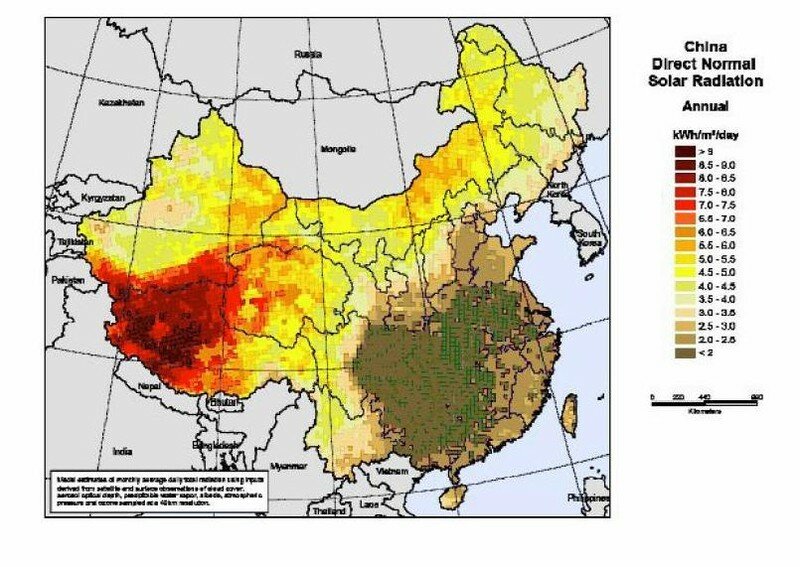
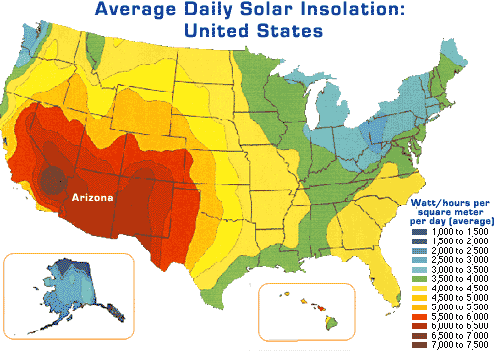
- ADEME, 2005 "L'ensoleillement direct français n'est pas suffisant pour envisager des projets sur le territoire national"Tiennel a écrit :La recherche en matière de solaire à concentration(MEDAD/DGEMP)


Les paris sont ouverts :Solar's Day In The Sun
15-10-2007, BusinessWeek
The big hurdle has been finding a technology that can match the low cost of fossil fuel. John O'Donnell thinks he has that licked. John O'Donnell started thinking about saving the world 30 years ago. In his first job, in the late 1970s, he worked to harness fusion--the nuclear reaction that powers the sun--at Princeton University's famed Plasma Physics Lab. "The sense was, if it was successful it would change the world," O'Donnell recalls. (...)
(...) Spanish clean-energy giants Abengoa Bioenergy and Acciona have jumped in with projects in Spain, Algeria, and the U.S. Israel's Solel Solar Systems has contracted with PG&E to deliver 553 MW from future plants. BrightSource Energy in Oakland, Calif., has reunited some of the pioneers who, in the 1980s, built nine solar plants in the Mojave Desert. "With Ausra, the Spanish companies, and Israel, the solar space has gotten very competitive," says Michael R. Peevey, president of the California Public Utilities Commission.
THE 10 cents SOLUTION
With utilities scrambling to meet mandates for green power in 25 states plus the District of Columbia, analysts say there's room for many companies. Ultimately, the technologies that deliver reliable power at the lowest price will win. They'll be a big success if they supply electricity at a price close to a new coal or natural gas plant today. The magic figure is 10 cents per kilowatt-hour (kwh) or less. "If we can lock in a 10 cents number for the life of a solar plant, it will be a clear winner," says Mark Kapner, senior strategy engineer at Austin Energy.
There's an intense debate about which of the competing solar thermal approaches will hit that target--and whether it's imminent or 5 or 10 years away. Ausra's unique claim is that its simpler technology brings it down to the crucial 10 cents already--even with the extra risk premium investors are demanding. "They've engineered out a lot of the costs," explains Lewis Hay III, CEO of Florida Power & Light. Competitors acknowledge they're at least a few years behind in making their approaches as cheap as Ausra claims to have done, even though most experts agree such cost reductions are going to happen.(...)
http://www.businessweek.com/magazine/co ... ries_ssi_5
Une stratégie bien plus efficace...(...) O'Donnell can be found in governors' or senators' offices, or telling a staunchly conservative rural Nevada county commissioner not about the threat of global warming but about all the good jobs solar generating plants will provide. Officially Ausra's executive vice-president, "John has been the evangelist," says Lane.
Ceci est vraiment intéressant à titre personnel : ma forte volonté pour promouvoir le solaire concentré thermodynamique (forte volonté qui irrite parfois certains internautes pour le coté évangeliste) trouve sa source exactement dans le constat qu'a fait O'Donnel sur la gravité du réchauffement climatique (Un clin d'oeil climatique a TiennelFor O'Donnell, the journey began in the summer of 2005, when he heard a talk by Nobel laureate Steven Chu, director of Lawrence Berkeley National Laboratory. "Chu said that everything you've heard about climate change is wrong. It is much worse than people know--and every engineer should be working on it," O'Donnell recalls. He got his chance the following April when he left Equator, the video-processing chip company he had founded, with about a year's salary. He traveled to conferences, read scientific papers, talked to researchers, and became convinced Chu was right. Yet averting the now familiar perils of global warming--floods, fierce storms, and famine--requires almost unimaginable changes. It means slashing emissions of CO2 by a mind-boggling number--up to 80% within 40 years, according to the latest report from the Intergovernmental Panel on Climate Change (IPCC).
(...)
).Oui, les pseudo-écolos du dimanche, c'est pas avec eux que l'on va réussir à faire face au défi du réchauffement climatique...(...) O'Donnell quickly rejected nearly all the proposed replacements. The use of so-called clean coal requires capturing and storing carbon, which is too costly and impractical, he concluded. The usual green darlings, wind turbines and panels of solar cells, fall short. When the afternoon sun scorches and people crank up their air conditioners, the breezes typically die. "Wind can't be relied on over the peak hours," says Fong Wan, vice-president for energy procurement at PG&E. Therefore, it can supply only 15% to 20% of electricity needs.
Neither can solar photovoltaic panels make much of a dent because they're too expensive. "Solar PV is a nice business, but it has nothing to do with climate," says O'Donnell.
He doesn't hide his disdain for many in the green camp. "A lot of people in the environmental community act as if they can't count," he complains. "If we are really serious about this, we have to have something that's large enough at a cost that makes sense, and which can power the U.S. and Europe--and also go to China and India."
C'est également ma conclusion.By the spring of last year, O'Donnell concluded that the only feasible approach was concentrated solar thermal technology, covering the ground with acres of mirrors to make steam to drive turbines. (...)
Pourvu que cela soit le cas !(...) "If it can compete with coal even at the beginning of the learning curve, it will change the world." (...)
Black & Veatch Corp : http://www.bv.com(...) Khosla still had questions. "We knew it would work, but at what cost and what level of performance?" Khosla says. "Would the glass delaminate after 15 years, or the coating on the tubes deteriorate?" Khosla paid the engineering firm Black & Veatch Corp. to study the array in Australia. "It's very atypical for venture capital to spend that much on diligence," Khosla says. PG&E also sent engineers. The results were good. (...)

On peut difficilement ne pas être enthousiaste !(...) "We have the vision, the connection to larger problems, the fundamental science, the commercial team, and the finance team." (...)
(...) Basic physics shows enough sunlight falls on the deserts of the Southwest to provide all of American's electricity many times over--given enough mirrors. But O'Donnell is already thinking about the next step--going global. He figures Europe could get all of its electricity from Big Solar plants in Morocco.
Chine, Inde, Brésil, Mexique, Indonésie, Australie, USA, Afrique etc.He even has a sneaky China plan. "Frankly, the original goal for the company was to get an arms race started, where we move ahead in the U.S. and then China decides to get in on the act," he says. "If they copy us, that's fine! Fine!" (...)
Emerging Energy Research : http://www.emerging-energy.comGlobal Concentrated Solar Power
Markets and Strategies, 2007–2020
October 2007
http://www.emerging-energy.com/user/Glo ... PPromo.pdf
The recent announcements of two CSP projects coming online in Spain and the United States indicate that the tide is turning in favor of Concentrated Solar Power (CSP). Over 5,800 MW of Solar CSP projects are in planning stages worldwide, and the lion’s share is
expected to come online by 2012. Global Concentrated Solar Power Markets and Strategies 2007-2020 provides a comprehensive analysis of the global CSP markets, the strategies employed by the growing
list of developers, and the barriers facing the next generation technology. (...)
sur les raisons du mix énergétique mexicain :
Oui, c'est incroyable, mais c'est ainsi.Tiennel a écrit :Au fait, Transparence, toi qui est là-bas, ça serait intéressant que tu nous éclaires
Pas un poil de solaire alors que le potentiel y est incontestable - au moins 10 fois celui de la France. On note aussi le gaspillage éhonté consistant à brûler du pétrole pour faire de l'électricité : je sais qu'ils en ont plein mais ce n'est pas une raison suffisante.
Thar Desert – The NextGen Powerhouse of India
(...) In order to maximize the power output, the plant must be located at a place that receives a "plenty" of sun throughout the year. One such place in India is Thar Desert in west Rajasthan. Following characteristics of Thar Desert make it an ideal location for a solar thermal power plant (STPP) :
1. Area: 2.34 million km2
2. Solar Intensity: approx 6 kWh/m2/day
3. Sun Availability: 345-355 days in a year
4. Rains occur only for 10-20 days in a year
There are a few "Strategic Advantages" that Thar Desert presents, which would make it a NexGen Powerhouse of India. These are as follows :
(1) Strategic Location:
- South Boundary of Thar Desert : Arabian Sea is just 80-90 kms away and hence a STPP located at the south boundary can double-up as a water desalination plant also providing clean water to local people. Gujarat industrial cluster is also very near from the south boundary and hence the power generated can act as a peak power to these industrial units at a reasonable rate.
- North-East Boundary of Thar Desert : Power hungry states of Punjab, Haryana and Delhi can get peak power especially during hot summers with a STPP located nearby.
(2) As it is a desert, it is scantly populated and most of the land is government owned and hence land acquisition, relocation of local people and associated issues will be minimal.
(3) The local people live a tough life as the land is arid and there is no industry. These local people can get a means of livelihood in constructing and maintaining the STPP. STPP will usher-in an era of all round development in this area.
Initially, the STPPs would provide only "Peak-hour Power" i.e. only during daytime when solar energy is available. Later on, when the cost is reduced, the solar energy storage (in the form of say molten salts) can be built to provide power after sunset. (...) "
Suite : http://www.scribd.com/doc/335179/Thar-D ... e-of-India


- Lybie, initiative allemande :(...) To help Libya develop clean sources of power generation, the U.S. Department of Energy (DOE) is sending a team of experts from its National Renewable Energy Laboratory in Colorado to collaborate on concentrating solar power.
Many power plants use fossil fuels as a heat source to boil water and generate steam that rotates a large turbine that activates a generator that produces electricity. Concentrated solar power systems use mirrors that focus the sun to heat liquids to produce steam.
"Where humidity is relatively low and there are lots of sunny days, concentrated solar is an effective technology for producing energy," John Mizroch, principal deputy assistant secretary at DOE for energy efficiency and renewable energy, told USINFO, "and Libya is a very suitable country for these technologies."
The Libyans, he added, would like to use the technology for power generation and water desalination. (...) http://newsblaze.com/story/200710050953 ... ories.html
- Lybie, initiative francaise : ...Signature of a 3,000 MW strategic cooperation agreement with MAN and the Libyan Centre for Solar Research
http://www.spg-gmbh.com/news.asp?news_id=7
 ...
...Et on en revient à la notion transversale de mix énergétique constitué d'un maximum de sources d'énergie mettant en oeuvre des technologies d'origines différentes.sceptique a écrit : Le CSP est donc une solution régionale mais en aucun cas une solution globale. A comparer, entre autres, avec le PV et avec la biomasse. Et il ne faut surtout pas tout investir dans une seule technologie.
- Solar tres est une centrale à tour centrale (type PS10, Séville) : elle occupe une surface deux fois plus élevée qu'une centrale parabolic trought (Type Nevada Solar One ou ANDASOL) ou CLFR (Ausra et Solar Power Group) de puissance égale.sceptique a écrit : Je reprends les données de la centrale en Espagne "solar tres".
Ensoleillement 2000 kWh/m2/an
surface totale 142 ha
surface capteurs 300 000 m2 (30 ha soit 21%)
Energie électrique fournie 110 GWh = 110 000 MWh/an
Petit calcul.
Energie brute captée : 300 000 * 2 000 = 600 GWh
"rendement" : 110/600 = 18%
Et si on rapporte à la surface totale (142 ha)
Energie brute captée : 1 420 000 * 2 000 = 2840 GWh
"rendement" : 110/2840 = 4%. Dans les calculs "il suffit de tant de km2 pour subvenir aux besoins de l'humanité" on peut donc déjà appliquer un facteur multiplicatif de 25.
Si on compare au PV ("rendement" 10%) on aboutit donc à des chiffres du meme ordre de grandeur. Maintenant, le PV est plus adapté à une production délocalisée, par exemple sur les toits des habitations. Il "récupère" ainsi des surfaces déjà occupées.
)sceptique a écrit : Le CSP nécessite des grands espaces fortement ensoleillés et correspond plus à une vraie centrale. Comme le dit bien Gilles, il va s'implanter naturellement dans ces régions bien particulières : Sud de l'Espagne, Californie, Nevada ... Mais les projets de faire de grandes centrales au Sahara pour alimenter l'Europe sont illusoires. Il suffit de voir les problèmes majeurs de sécurité de l'approvisionnement en gaz et en pétrole depuis des pays jugés peu sûrs. On peut faire (et on fait !) des stocks gigantesques de gaz et de pétrole pour pallier à des ruptures d'approvisionnement. Et on a même tendance à augmenter ces stocks. Or, le courant électrique produit par le CSP ne se stocke pas, en tout cas pas dans les bons ordres de grandeur. Il s'en faut d'un facteur 100.
Par contre, le CSP me semble tout à fait adapté pour l'approvisionnement énergétique des pays d'Afrique du Nord et la désalinisation de l'eau de mer. Le CSP est donc une solution régionale mais en aucun cas une solution globale. A comparer, entre autres, avec le PV et avec la biomasse. Et il ne faut surtout pas tout investir dans une seule technologie.
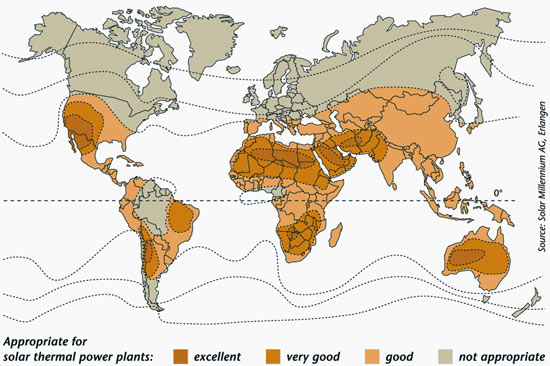
 Pays qui disposent de sites excellents pour le CSP (solaire à concentration) : Pays qui ne disposent pas de sites excellents mais de sites très bons : Pays qui ne disposent pas de sites très bons mais de sites bons : Pays qui ne disposent pas de sites appropriés pour le CSP (mais qui peuvent être alimentés via transfert HVDC ) : :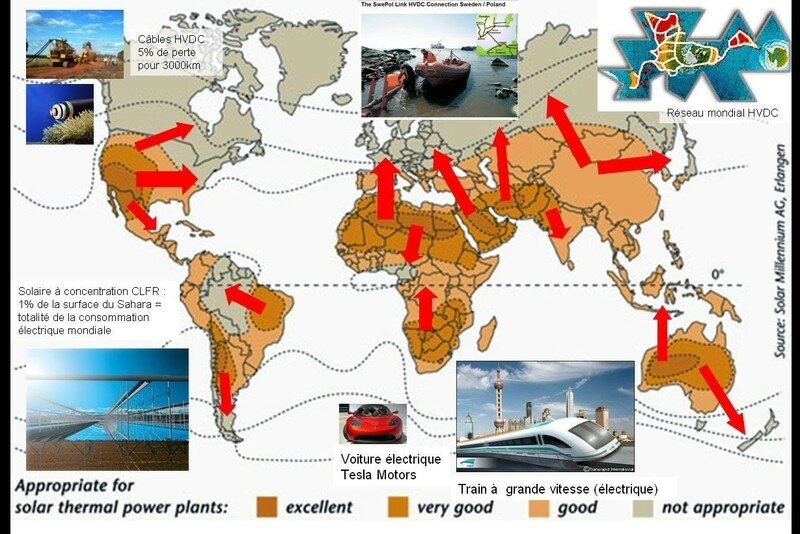
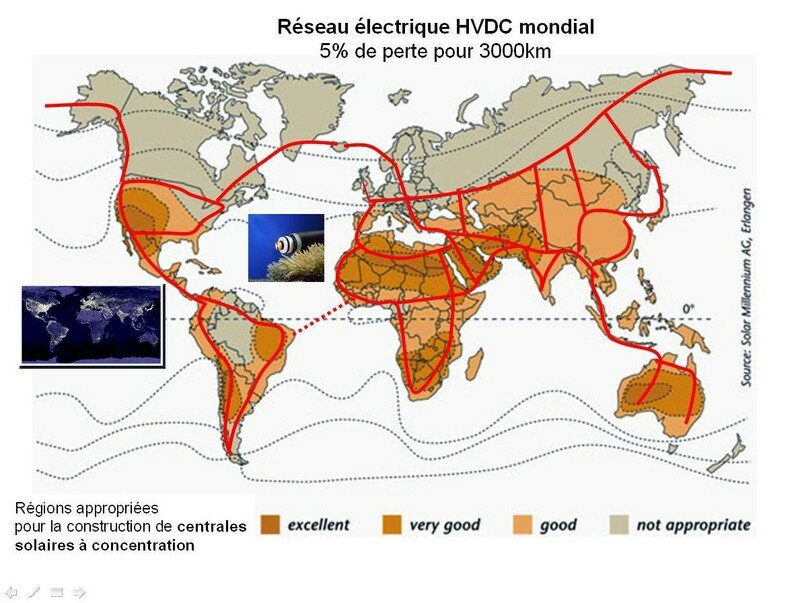


Je pense qu'il vaut mieux leur offrir les moyens de devenir autonomes : construire en Afrique des centrales solaires (exportation d'une partie de la production vers l'Europe), centrales couplées à des unités de desalinisation de l'eau de mer (eau douce - > cultures) plutôt que d'injecter en permanence des sacs de riz produits ailleurs, ce que l'on fait actuellement (dépendance alimentaire).Tiennel a écrit :Dans le même ordre d'idée, les excédents alimentaires US et européens pourraient aller nourrir les populations affamées d'Afrique.
La technologie est disponible (sacs, containers, bateaux) mais ce sont une fois de plus de bêtes problèmes géopolitiques qui coincent