Publié : 10 nov. 2007, 21:07
ca devient vraiment n'importe quoi là....
Site dédié à la fin de l'âge du pétrole
https://www.oleocene.org/phpBB3/

Quand, après les USA, la Chine et l'Inde vont se lancer massivement dans le solaire CSP, la partie sera gagnéePotential for solar energy large in India
India Times, 10 novembre 2007
In India, the prospect of solar energy is sunny but without being too hot. Today, the country generates almost 1,748 MW power through solar energy. That’s a pittance when compared to India’s total demand of almost 1.3 lakh MW every year. However, companies with investments in the technology believe that the potential for solar energy is much larger than the above share.
“In the next five years, I see solar technology supplying a major part of the world’s energy requirement,” says Ratul Puri, Executive Director, Moser Baer. Mr Puri wouldn’t believe otherwise. In the last couple of years, he has invested almost Rs 161 crore in the manufacturing of photovoltaic solar cells and panels.
The company also has plans of investing another Rs 330 crore for setting up a silicon photovoltaic cell manufacturing plant for which it has tied up with Applied Materials. Solar Semiconductor, another photovoltaic manufacturing entity has lined up an investment of $40 million to set up two production units in Andhra Pradesh.
Globally, the demand for solar technology was almost $2 billion in 2003, which has increased to $15 billion in 2006 and is expected to reach $100 billion by 2015.
However in India, the growth story has been limited to either villages with no distribution networks or the government’s initiative of using clean energy for public lighting systems. Over the last three years, almost 3,000 villages have tapped into solar technology to fulfill their basic needs of lighting, heating, cooking and entertainment.
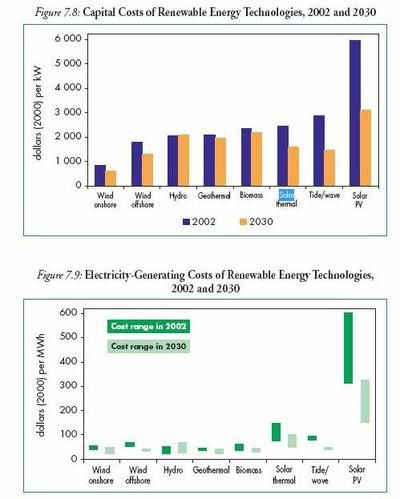
Almost 55,000 street lighting systems in the country are also being powered on solar energy. But, commercial users are not excited. That’s because price matters. And it's probably the only deterring factor that puts solar energy late in the contention list of renewable sources that India can tap into in the wake of over-the-top crude oil prices. Today, the cost of producing a single unit of solar energy from photovoltaic cells ranges from Rs 15 to Rs 30 as compared to Rs 2 to Rs 6 per unit for thermal energy.
In fact, the capital cost would be to the tune of almost Rs 25 crore to set up a photovoltaic plant that generates 1 MW electricity. This very high and precisely the reason that makes it unattractive for commercial uses for now. “Solar technology has still not reached a stage where it can be used for economic solutions,” says P Ramesh, managing director, Energy Division, Feedback Ventures. “While the establishment cost is high, the cells also need to be replaced every 7 to 8 years. In a commercial situation, that makes the technology hugely inappropriate,” he adds.
This is exactly where innovation can play a big role. “Photovoltaic doesn’t seem to be making the cut and my hopes are on another solar technology, Concentrate Solar Power (CSP). Energy is generated using mirrors to focus sunlight, producing heat. There is no need for silicon and this is almost 50% cheaper,” says G M Pillai, director general, World Institute of Sustainable Energy (WISE).
Already being used in the US, the technology is still in the pilot project stage in India. Mr Puri, though, believes that it’s just a matter of time when solar technology becomes competitive. “While the costs of other sources have been increasing, historically, the cost of solar technology has been declining at a rate of almost 3-4% per annum. In fact, over the next five years, I believe the costs will come down by 10%,” he says. Another positive is that solar technology is a very clean energy, and since there is so much of sun that India gets it is quite possible that Indians will adopt solar in a big way.
http://economictimes.indiatimes.com/The ... 531030.cms
 :
:A shining light in the desert
Every year, each square kilometre of hot desert receives solar energy equivalent to 1.5 million barrels of oil. Multiplied by the total area of deserts world-wide, this is nearly a thousand times the entire current energy consumption of the world. Given our concerns about energy supplies and the need to cut CO2 emissions, these rather startling statistics seem to be a cause for optimism.
But, you may very reasonably ask: Can we tap into this enormous source of energy at a reasonable cost? Can we get it to where people are living? And, if those things are possible, what other snags or problems might there be? The purpose of this article is to describe some answers to those questions and suggest that one’s initial sense of optimism may be something more
than just a mirage.
http://www.trec-uk.org.uk/articles/CSP_ ... v_2007.pdf
Transparence a écrit :A ne pas rater dans Environmental Scientist ce mois-ci.
http://www.trec-uk.org.uk/articles/CSP_ ... v_2007.pdf


Olâ !! Stop au feu !Transparence a écrit :....
Nous on veut du noir, du sinistre, des gens qui ne peuvent plus payer, des punitions, des privations, des effondrements, des canons, des cris, du sang !
beau calcul Gilles !GillesH38 a écrit :autre "détail" : un carré de 110kmx110km fait donc 121 000 km^2. Si la durée de vie est de 30 ans, on a donc a changer chaque année 4000 km^2 de récepteurs, donc 4 milliards de m^2/an, soit environ 10 millions de m^2 par jour .

non, il n'y a aucune conclusion à en tirerKrom a écrit :La conclusion à tirer c'est qu'une production ultra-centralisée (plusieurs dizaines de pourcent de la consommation européenne dans le Sahara) est insoutenable.
Une réponse a déjà été donné à cette question :valid a écrit :Je réitère ma question posée ailleurs (puisque le lien vers ce fil ne me satisfait pas) : avec quoi vous fabriquez tous vos bidules CSP ?
Le Payback Enregy time du CSP est de 5 mois.valid a écrit :Si on retire le pétrole de l'équation CSP, est-ce que le CSP tourne encore ?
ou encore, 100 milliard de cm2 ou encore 10 000 miliards de millimètres carrésGillesH38 a écrit : 10 millions de m^2 par jour.

Oui, tu fais bien de le souligner, les ENRs constituent un formidable moteur pour l'emploi et les activités économiques, directement et indirectement.GillesH38 a écrit : nécessitent un certain nombre de travailleurs
Non, pour optimiser la production (variabilité météo), des centaines de centrales seront réparties sur plusieurs pays : Maroc, Tunisie, Algérie, Lybie, Egypte.Krom a écrit :La conclusion à tirer c'est qu'une production ultra-centralisée (plusieurs dizaines de pourcent de la consommation européenne dans le Sahara)...
Conclusion infondée et erronnée.Krom a écrit :... est insoutenable.
Transparence, tu éludes complétement la question !Transparence a écrit :ou encore, 100 milliard de cm2 ou encore 10 000 miliards de millimètres carrésGillesH38 a écrit : 10 millions de m^2 par jour.
10 km2 (un carré de 3,3km de coté), à l'échelle mondiale, c'est ridicule. C'est 15cm2 par être humain. L'équivalent d'une toute petite boîte de conserve
