Page 34 sur 34

Re: Terres rares : Exploration et production miniére

Publié : 08 nov. 2026, 11:59
par energy_isere
suite de ce post du 23 sept 2026 : viewtopic.php?p=2427172#p2427172

Rare Earths Norway va lancer une usine pilote de traitement de terres rares du gisement de Fen en Norvége :
Rare Earths Norway €24m Fen pilot plant: flowsheet and zoning notes for mine planners

November 5, 2026 Reviewed by Tom Sullivan

Rare Earths Norway has approved a €24-million pilot plant at Ulefoss to test an integrated ore-to-rare-earth-oxide flowsheet for the Fen deposit, which holds 123 million indicated tonnes at 1.35% TREO plus 1.08 billion inferred tonnes at 1.31% TREO. The plant, housed in an existing industrial building and targeting 6,000 tonnes of ore over three years, is slated to start up in Q3 2027 with funding support from Innovation Norway, the Telemark Development Fund and EIT RawMaterials. Design changes include increasing the protective rock cover above underground openings from 25 m to 100 m, while a state-led zoning process aims to fix mine, plant, tailings and infrastructure locations by 2028.

Technical Brief
Protective rock cover between underground workings and surface increased fourfold, from 25 m to 100 m.
Resource update effective 31 December nearly doubled contained oxides to 15.9 million tonnes.
Indicated resource now 123 Mt TREO, with neodymium–praseodymium oxides forming about 19% of TREO.
Inferred resource totals 1.08 Bt at 1.31% TREO, containing 14.2 Mt rare earth oxides.
Approximately 30,000 m of drill core logged and assayed, including 10,000 m from the latest campaign.
Zoning process, taken over by Norway’s government in April, targets completion by 2028.
National zoning will fix locations and conditions for underground mine, processing plant, tailings and associated infrastructure.

With 19% of Fen’s rare earth oxides in NdPr, as highlighted in the March 2026 resource update, Rare Earths Norway is positioning this Norwegian asset in the same high-value magnet segment that LKAB’s Per Geijer project targets, which could sharpen competition for EU downstream magnet and motor manufacturers.

The roughly 80% jump in contained oxides at the Fen deposit since the earlier 2024 figure, referenced in our prior coverage, means the €24-million pilot is effectively de-risking flowsheet and permitting for what now screens as one of Europe’s larger rare earth inventories rather than a marginal test asset.

Norway’s backing via Innovation Norway and the Telemark Development Fund, combined with EIT RawMaterials’ EU-level involvement, signals that Fen is being treated as a strategic rare earths project for Europe, in contrast to many of the smaller rare earth items in our database that lack this kind of coordinated national–EU support.
https://www.geomechanics.io/news/articl ... e-planners

https://www.rareearthsnorway.com/news/r ... lot-plant/
Re: Terres rares : Exploration et production miniére

Publié : 11 nov. 2026, 16:19
par energy_isere
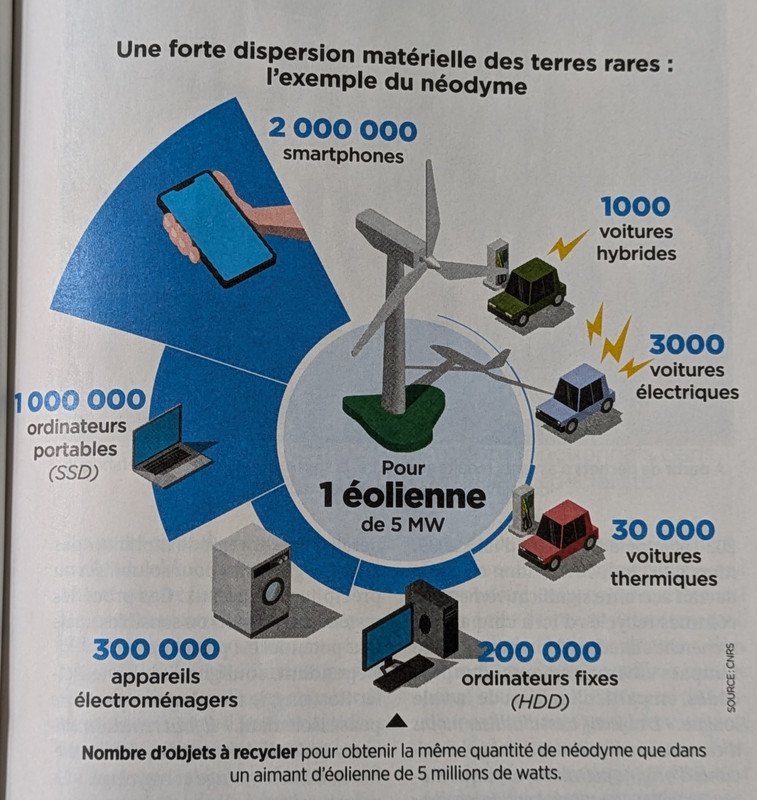
De l'importance du Néodyme pour les aimants dans les éoliennes

Image

source Sciences et Avenir, numéro spécial sur les Terres rares de 2026


question à Google Gemini :
quelle est la production mondiale de Neodyme, en tonnes, dans le monde ?
Réponse Google Gemini :
La production mondiale de néodyme s'élève à environ 55 000 à 65 000 tonnes d'équivalent oxyde de néodyme par an (sur un total mondial d'environ 390 000 tonnes d'oxydes de terres rares).
Les statistiques minières internationales (comme celles de l'USGS) regroupent l'ensemble des terres rares dans un panier global, car le néodyme n'est jamais extrait seul, mais séparé des autres minerais (il représente généralement 15 % à 18 % du volume total des terres rares extraites).

Re: Terres rares : Exploration et production miniére

Publié : 15 nov. 2026, 12:17
par energy_isere
suite de ce post du 27 sept 2026 : viewtopic.php?p=2427280#p2427280

Le gisement de terres rares du projet Homer au Brésil est plus vaste de 60% que dans les études préliminaires.
Rare Earths Americas doubles mineralized zone at Homer project in Brazil

Staff Writer | November 12, 2026

Image
Drilling at the Homer project in Brazil. (Image: Rare Earth Americas

Rare Earths Americas (NYSE American: REA) announced Thursday assay results from eight new drill holes at Homer-A, one of three 100%-owned exploration targets within the broader Homer project in Goiás, Brazil.

The latest results expand the known mineralized footprint by more than 60%, to approximately 3.5 km² (865 acres) from the 2.15 km² (531 acres) reported in September 2026.

The mineralized zone now extends approximately 4.3 km along its longest dimension—roughly double the 2.1 km reported in September—and remains open for further expansion, the company said.

Of the 20 holes within the primary geochemical anomaly with assays received to date, 19 have intersected mineralization above the reported cut-off, further supporting the scale and continuity of the system, REA said.

Holes along the south-eastern margin of the complex returned the highest proportion of heavy rare earth oxides (HREO) found at Homer-A to date, with dysprosium and terbium oxides (DyTb) making up as much as 8.7% of total rare earth oxides plus scandium in individual samples. Multiple holes in this area returned elevated HREO and DyTb proportions, highlighting an emerging zone of heavy rare earth enrichment along the south-eastern margin that remains open to further drilling, the company said.

Assays have been received for only 22 of approximately 180 holes planned for the 2026 program—roughly 12%—while approximately 11,800 meters, or nearly 80% of the planned 15,000-meter program, had already been drilled as of October 30, 2026.

“What stands out in this second update on drilling is that Homer-A is becoming both larger and increasingly differentiated, REA CEO Donald Swartz said in a news release.

“The known mineralized footprint has expanded by more than 60%, its longest dimension has roughly doubled, and drilling along the south-eastern margin has encountered the highest heavy rare earth and dysprosium-terbium proportions we have seen to date,” Swartz said. “The heavy rare earth enrichment is occurring across multiple holes and intervals rather than in a single isolated sample, while the mineralized system remains open for further expansion.”

The company said it expects to finish the program on schedule and continues to target a maiden mineral resource estimate in 2027.

Rare Earth Americas controls four exploration projects, including ionic clay deposits in Brazil and a monazite-rich sands project in Georgia that management believes could represent the source rock for rare earth-bearing mineral sands already mined along the US coastal plain.

REA stock closed Thursday down 10% in New York. The company has a $220 million market capitalization.
https://www.mining.com/rare-earths-amer ... in-brazil/

Re: Terres rares : Exploration et production miniére

Publié : 15 nov. 2026, 12:22
par energy_isere
suite de ce post du 26 avril 2026 : viewtopic.php?p=2423783#p2423783
USA Rare Earth begins Brazil shipments to Pentagon

Marina Meireles | November 11, 2026

USA Rare Earth (Nasdaq: USAR) has started to ship mixed rare earth carbonate to the Pentagon funded special purpose vehicle US SIIE LLC from its Serra Verde’s Pela Ema operations in Brazil.


Commercial-scale shipments of mixed rare earth carbonate (MREC) started in October,with the first sales scheduled for this month, as part of the 15-year long 100% take-or-pay offtake agreement the company has with the US government.

The agreement provides floor prices for rare earths vital to produce an advanced permanent NdFeb magnet, a key product for the development of clean energy systems, generators and electronics.

“USA Rare Earth is the only scaled producer outside Asia of the vital heavy rare earths used in advanced permanent NdFeB magnets,” CEO Thras Moraitis said. “The start of commercial-scale shipments of MREC to our offtake partner is a defining milestone for USA Rare Earth and for the broader effort to build a secure, reliable and responsible non-China supply chain for the heavy rare earths that power tomorrow’s modern economy.”

The commercial shipments come at a time when Brazil and most Western governments are moving to protect its mineral resources to develop its potential domestically. The Brazilian federal government defined rare earths as a high-priority critical mineral in early November.

The neodymium, praseodymium, dysprosium and terbium needed to produce the magnet are coming from Serra Verde’s Phase 1 expansion, where production is ramping up towards an initial run rate of 4,000 tpa TREO by Q2 2027.

Shares in USA Rare Earth were up 10.8% to $8.78 apiece by mid-day Wednesday in

New York, valuing the company at $3.1 billion.

Serra Verde expansion
USA Rare Earths is currently expanding its Serra Verde operations in the state of Goiás in Brazil, and this new commercial shipping is a result of that.

The company said stage 1 of the optimization and expansion program was completed and commissioned within budget and on time, and commercial-scale production restarted with volumes and product quality being delivered as planned.

“We are ramping up and the optimized process is performing as we anticipated, with product quality ahead of planned specification, meeting our contractual obligations. We aim to continuously improve our execution and remain focused on ramping up production and shipments in a sustainable and responsible manner,” USA Rare Earth head of upstream in Brazil, Ricardo Grossi said.

The company is looking to ramp up annual production to 6,400 tonnes of TREO by the end of 2027, as it evaluates a possible Phase II expansion that could double output.


“As the first scaled processor of heavy rare earth-rich ionic clays outside Asia, Serra Verde’s processing technology is exclusively home grown, underlining the deep innovation and operational capabilities in Brazil,” Grossi added.

Offtake agreement

The agreement captures the current premium for heavy rare earths outside of China, pricing neodymium and praseodymium at $110/kg, dysprosium at $575/kg and $2,050 for terbium. USA Rare Earths said that the floor prices help derisk cash flows and incentivize investment in rare earth’s upstream production, while protecting production against any non-economic supply from other producers.

The company said that recent non-China prices for dysprosium oxide are up to 16 times higher than Chinese prices, and recent prices for terbium oxide are up to 9 times higher.

USA Rare Earths also receives 70% of the non-China market price above the applicable floor, less a fixed separation cost. Once the rare earth elements are separated, USA Rare Earth’s supply earns revenue from remaining valuable heavy rare earth elements, including yttrium.
https://www.mining.com/usa-rare-earth-b ... -pentagon/

Re: Terres rares : Exploration et production miniére

Publié : 15 nov. 2026, 12:29
par energy_isere
suite de ce post du 06 dec 2011 : viewtopic.php?p=306364#p306364
Gabon seeks $2 billion to revive Mabounie rare earths project

Bloomberg News | November 8, 2026

Gabon is looking to revive its long-stalled Mabounié niobium and rare-earth project through a proposed $2 billion development involving Emirati-backed New Energy Metals and the Chinese engineering group ENFI.


New Energy Metals and its subsidiary Dusk Gabon presented a technical study for the project to President Brice Clotaire Oligui Nguema during his visit to Beijing last week, according to a statement on the presidency’s Facebook page.

If it goes ahead, the development is expected to create more than 2,500 direct jobs and include processing facilities in the Central African country. Construction is scheduled to start in 2027.

Mabounié, about 200 km (124 miles) southeast of Gabon’s capital of Libreville, has been prospected for years but hasn’t reached commercial production. The statement didn’t add any details on how the project would be financed or on the respective roles of NEM and ENFI.
https://www.mining.com/web/gabon-seeks- ... s-project/