Japanese companies to build world’s largest liquefied hydrogen carrier
Kawasaki Heavy Industries and Japan Suiso Energy will construct a 40,000 cubic meter vessel designed to meet global hydrogen demand in the 2030s.
January 6, 2026 Patrick Jowett
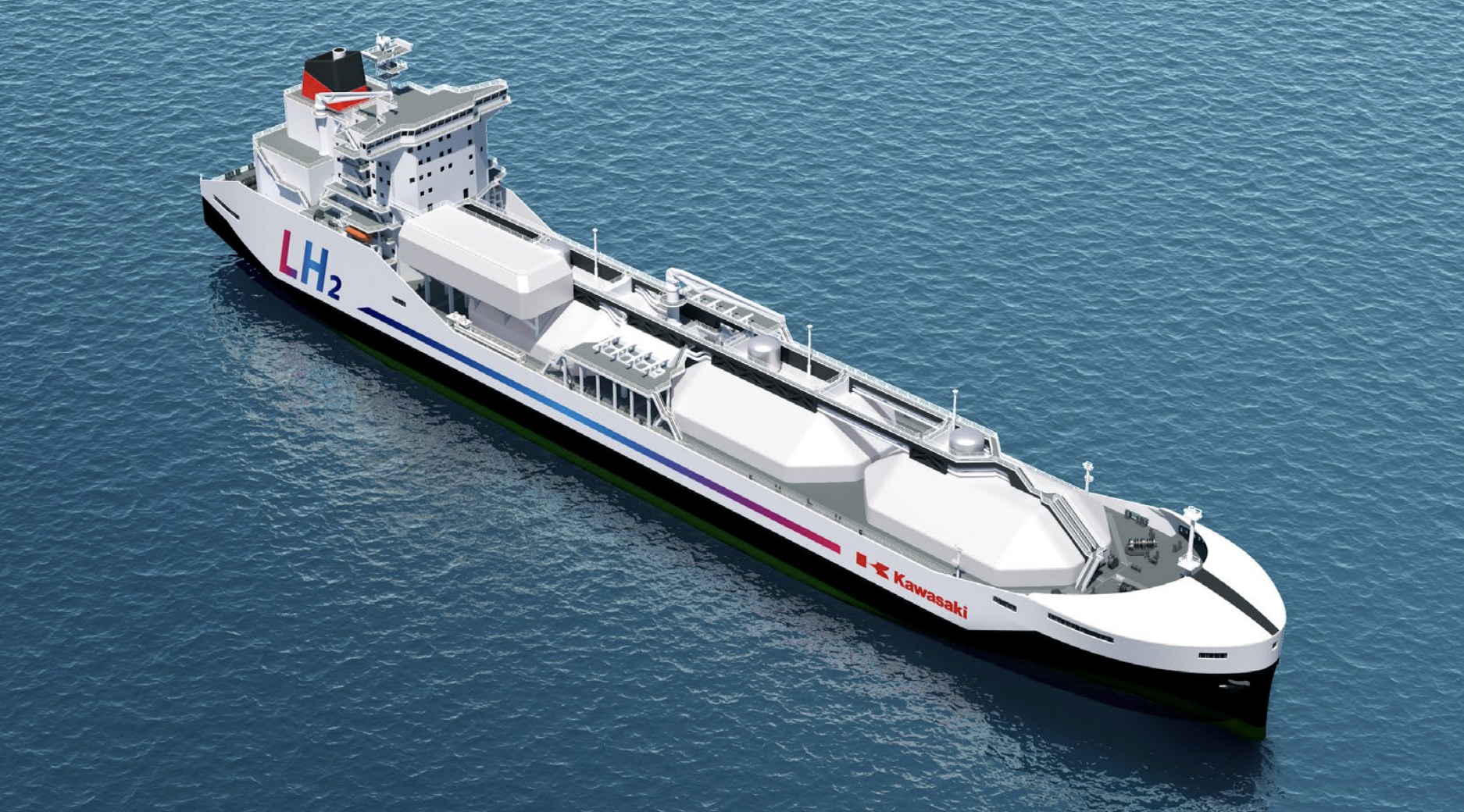 An artist's impression of the hydrogen carrier / Image: Kawasaki
Japan’s Kawasaki Heavy Industries and Japan Suiso Energy (JSE) have signed a contract to build the world’s largest liquefied hydrogen carrier.
The vessel is expected to have a capacity of 40,000 cubic meters. It will be built at Kawasaki’s Sakaide Works in Kagawa prefecture, Japan.
Kawasaki Heavy Industries said in a statement that the project will meet global hydrogen demand in the 2030s and form the foundation of the future hydrogen supply chain.
The carrier will be about 250 meters long, feature a diesel- and hydrogen-fueled electric propulsion system, and travel at about 18 knots (33.3 km/h). It will be equipped with cargo tanks for liquefied hydrogen and use a high-performance insulation system, which will reduce the generation of boil-off gas caused by natural heat ingress, enabling large-scale transportation of cryogenic liquefied hydrogen.
The vessel will also feature a cargo headline system capable of loading and unloading large volumes of liquefied hydrogen. Kawasaki Heavy Industries said double-wall vacuum jacketed piping will keep materials at an extremely low temperature, allowing for efficient and safe transfer between the onshore facility and liquefied hydrogen tanks on board.
Kawasaki Heavy Industries constructed the world’s first liquefied hydrogen carrier, with a capacity of 1,250 cubic meters, in 2021. A year later, it participated in a pilot demonstration of liquefied hydrogen export between Australia and Japan.
The company has since established a liquefied hydrogen receiving terminal, known as Hy touch Kobe, and is currently working on Kawasaki LH2 Terminal, a liquefied hydrogen base under construction in Ogishima, Kawasaki, Kanagawa prefecture.
JSE is the operator of the New Energy and Industrial Technology Development Organization's (NEDO) Green Innovation Fund project, supported by the Japanese government, which aims to demonstrate ship-to-base loading and unloading of liquefied hydrogen, as well as conducting ocean-going trials, by the end of March 2031.