https://www.world-nuclear-news.org/arti ... ear-outageSouth Korean reactor restarts after three-year outage
7 April 2026
Korea Hydro & Nuclear Power has restarted unit 2 at its Kori nuclear power plant, which had been offline since its original 40-year operating permit expired in April 2023.
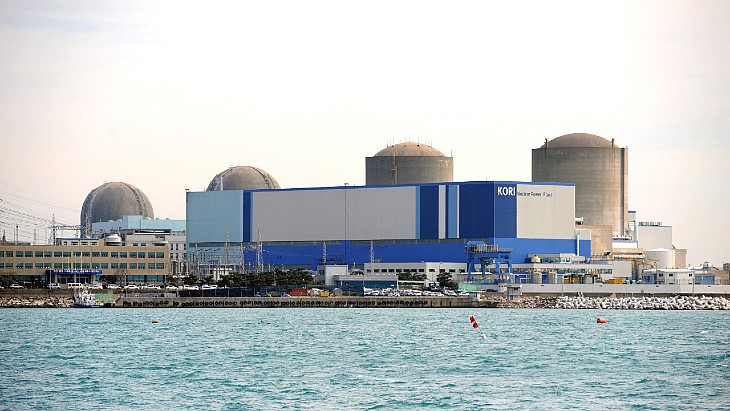
The four-unit Kori plant pictured in 2008 (Image: Korea Kori NPP/IAEA image bank)
The company said the unit resumed operations on 4 April "after successfully completing a 35-month facility improvement project for continued operation". During the shutdown period, facility improvements and safety inspections were carried out to enhance the power plant's safety and performance.
Kori unit 2 - South Korea's second nuclear power reactor - began commercial operation in August 1983. The 685 MWe pressurised water reactor's operating permit expired on 8 April 2023, and it has remained offline since. Korea Hydro & Nuclear Power (KHNP) submitted a safety assessment report for continued operation of Kori 2 in April 2022 and applied for a permit for continued operation, including the results of a public opinion survey on the radiation environmental impact assessment.
The Nuclear Safety and Security Commission (NSSC) approved the continued operation of Kori unit 2 until 2033 in November last year and gave KHNP permission to restart the reactor last week following final inspections.
"In a situation where energy supply instability persists, the continued operation of nuclear power plants based on safety is an important means of securing national energy security," said KHNP President Kim Hoe-cheon. "Starting with the successful continued operation of Kori Unit 2, we will thoroughly prepare for the continued operation of the nine nuclear power plants currently underway to do our best to ensure a stable power supply, and through this, we will strive to contribute to the national economy and carbon neutrality."
KHNP is currently submitting safety assessment reports for the continued operation of nine other nuclear power units (Kori 3 and 4, Hanbit 1 and 2, Hanul 1 and 2, and Wolsong 2, 3, and 4), whose operating licences expire before 2030, to the NSSC for review.
Operation of units 3 and 4 at the Kori plant was suspended in September 2024 and August last year, respectively, as their 40-year design lives had expired.
Unit 1 of the Kori plant was permanently shut down in June 2017, after 40 years of operation, and become the first South Korean reactor to enter decommissioning. KHNP submitted its application to dismantle the unit to the NSSC in May 2021. The regulator approved the decommissioning of Kori 1 in June last year.
"As Kori unit 2 serves as the lead power plant among the 10 nuclear power plants pursuing continued operation with licences expiring by 2030, KHNP plans to ensure even safer continued operation for the subsequent nine plants, including Kori units 3 and 4, by thoroughly implementing safety reviews by regulatory authorities and facility upgrades to enhance performance," the company said.
Le nucléaire Sud-Coréen
Modérateurs : Rod, Modérateurs
-
energy_isere

- Modérateur

- Messages : 107660
- Inscription : 24 avr. 2005, 21:26
- Localisation : Les JO de 68, c'était la
- Contact :
Re: Le nucléaire Sud-Coréen
Prolongation de la durée de vie du réacteur Kori unit 2 en Corée du Sud :
-
energy_isere
- Modérateur
- Messages : 107660
- Inscription : 24 avr. 2005, 21:26
- Localisation : Les JO de 68, c'était la
- Contact :
Re: Le nucléaire Sud-Coréen
en relation avec ce post du 31 mai 2025 : viewtopic.php?p=2412062#p2412062
https://www.world-nuclear-news.org/arti ... nul-unit-4Construction starts for Shin Hanul 4
Friday, 29 May 2026
First concrete has been poured for the reactor building of South Korea's Shin Hanul nuclear power plant's unit 4, marking the official start of construction.
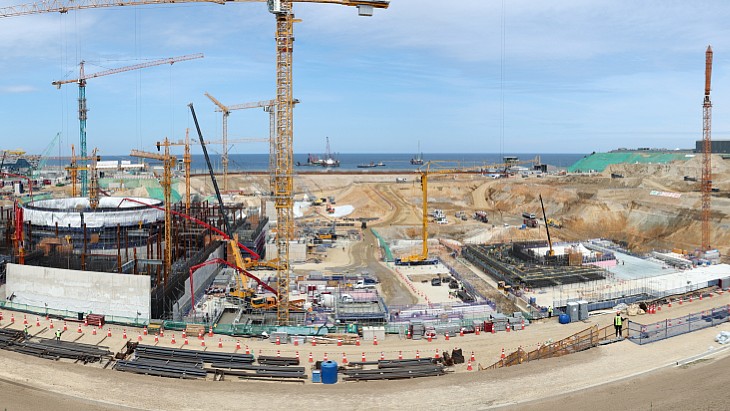
Construction work is under way on both Shin Hanul 3 and 4 (Image: KHNP)
Korea Hydro & Nuclear Power said the initial pouring of concrete for the foundation began on 29 May. Construction permits for Shin Hanul units 3 and 4 - APR1400 units - were issued in September 2024, with first concrete poured for unit 3 in May 2025.
Kim Hoe-cheon, KHNP President, said: "Shin Hanul Units 3 and 4 are a solid foundation that will support Korea’s energy future, just like the concrete being constructed now. Let us build world-class nuclear power plants with safety as our top priority, with a sense of mission to contribute to achieving the national carbon neutrality goal."
KHNP said that Shin Hanul 4 is targeted for completion in 2033, with unit 3 scehduled for operation a year earlier. Once both units are completed it says they are expected to supply 46% of the annual power requirements of the Gyeongbuk region.
...................................
-
energy_isere
- Modérateur
- Messages : 107660
- Inscription : 24 avr. 2005, 21:26
- Localisation : Les JO de 68, c'était la
- Contact :
Re: Le nucléaire Sud-Coréen
https://www.world-nuclear-news.org/arti ... -new-buildSites selected for Korean nuclear new build
Thursday, 18 June 2026
Yeongdeok in North Gyeongsang Province has been selected by Korea Hydro & Nuclear Power for two new large-scale nuclear reactors. Gijang, in Busan, has been chosen to site a new small modular reactor.
South Korea's 11th Basic Plan - which covers 2024 to 2038 - calls for two new large nuclear power reactors with a combined capacity of 2.8 GWe and 700 MW of small modular reactor capacity to be built by 2038, in addition to the large reactors already under construction or planned.
Korea Hydro & Nuclear Power (KHNP) launched a bidding process to select the host cities or towns in January, days after the government confirmed plans to construct the reactors by 2038. Two regions - Ulju, in Ulsan and Yeongdeok, in Gyeongbuk (North Gyeongsang) - applied for the large nuclear power plant, while the regions of Gyeongju-si in Gyeongbuk and Gijang, in Busan, applied to host the small modular reactor (SMR) by the 30 March deadline.
The sites were then reviewed by the New Nuclear Power Plant Site Selection Evaluation Committee of external experts in policy/humanities, environment, nuclear power, and geology/seismology which was set up by KHNP in April last year. The committee carried out basic site and environmental surveys, on-site inspections and a public opinion survey on the applicant sites.
"Based on the objective data collected through these processes and the site evaluation criteria, the committee conducted a comprehensive evaluation and selected Yeongdeok-gun for the Large Nuclear Power Plant and Gijang-gun for the SMR as the candidate sites for the new nuclear power plants," KHNP said.
"A stable power supply is essential for securing national competitiveness and for future generations," the Site Selection Committee said. "Our committee strove to find the optimal location by prioritising regional co-prosperity and the role of the plant as a base load power source to sustain the industrial ecosystem."
The committee expressed its gratitude to the local governments and residents "who showed such fervent enthusiasm for hosting the project" and asked KHNP to "utilise the residents' opinions identified during the survey process - including reasons for support or opposition to nuclear power plant construction and suggestions for improvement - when formulating future cooperation plans with the region".
South Korea has four operational APR1400 units - Saeul units 1 and 2 (formerly Shin Kori 3 and 4) and Shin Hanul units 1 and 2. Four APR1400s are under construction as Saeul units 3 and 4 and Shin Hanul 3 and 4. Four APR1400 units have also been built at the Barakah nuclear power plant in the UAE, which are all now in commercial operation.
In February 2026, Korea's National Assembly passed the Special Act on the Promotion and Support of SMR Development, establishing a framework including a five-year basic plan and an SMR Development Promotion Committee. The Ministry of Science and ICT plans to invest KRW1200 billion (USD830 million) by 2030 in core technology designs for three domestically developed SMR types. A consortium led by KHNP and the Korea Atomic Energy Research Institute is developing the Innovative Small Modular Reactor (i-SMR) - an integrated pressurised water reactor type nuclear power plant with an electrical output of 170 MW for both domestic use and export.