https://www.world-nuclear-news.org/arti ... n-revealedKorean SMR-powered container ship design revealed
South Korea's HD Korea Shipbuilding & Offshore Engineering has unveiled a nuclear-powered container ship model utilising small modular reactor technology.
13 February 2025
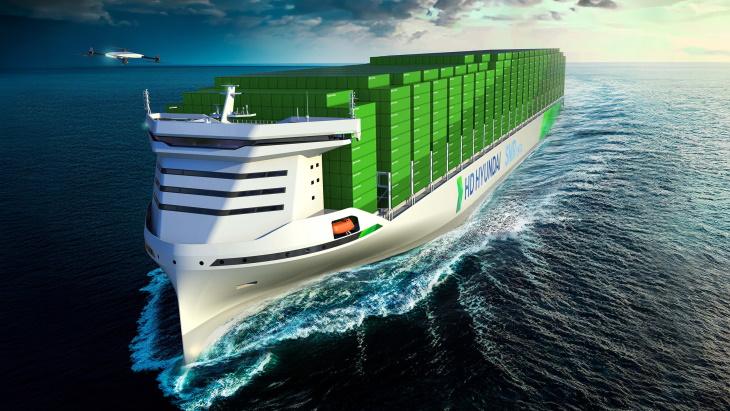
A rendering of a 15,000 TEU-class SMR-powered containership (Image: HD KSOE)
The design was revealed on 12 February at the New Nuclear for Maritime Houston Summit, held at the Asia Society Texas Center in Houston, USA.
Previously, HD Korea Shipbuilding & Offshore Engineering (HD KSOE) obtained Approval in Principle (AIP) from the American Bureau of Shipping (ABS) for a 15,000 TEU-class container ship design model applying small modular reactor (SMR) technology.
HD KSOE - a subsidiary of HD Hyundai - says the newly unveiled design model features enhanced economic efficiency and safety by incorporating actual equipment and safety design concepts. Unlike conventional ships, nuclear-powered vessels do not require engine exhaust systems or fuel tanks. The company has optimised the space previously occupied by large engine room equipment to accommodate additional containers, enhancing economic efficiency. It has also applied a marine radiation shielding system using a double-tank method with stainless steel and light water to ensure safety.
Furthermore, HD KSOE, in collaboration with global energy technology company Baker Hughes, has applied a supercritical carbon dioxide-based propulsion system, improving thermal efficiency by about 5% compared with existing steam-based propulsion systems.
HD KSOE said it plans to establish a marine nuclear demonstration facility at its Future Technology Test Centre in Yongin, Gyeonggi Province, to verify safety designs.
"HD KSOE is strengthening cooperation not only with major classification societies but also with international regulatory bodies to establish international regulations necessary for the commercialisation of nuclear-powered vessels," said Park Sangmin, Head of HD KSOE's Green Energy Research Lab, during a session at the summit. "Starting with the land-based SMR reactor manufacturing project, we aim to develop a marine nuclear business model by 2030."
In October 2023, a design for a floating offshore nuclear power barge from HD KSOE and Kepco Engineering & Construction (Kepco E&C) received approval in principle from ABS. Project collaborators included ABS, HD KSOE, Kepco E&C and the Liberian International Ship & Corporate Registry. The floating SMR barge is intended to serve as offshore power generation for remote communities and island electrification.
In January 2024, a memorandum of understanding was signed between Lloyd's Register, Zodiac Maritime, HD KSOE and Kepco E&C for the development of nuclear-propelled ship designs, including bulk carriers and container ships. Under the joint development project, HD KSOE and Kepco E&C will provide designs for future vessels and reactors while Lloyd's Register will assess rule requirements for safe operation and regulatory compliance models.
The following month, HD KSOE announced plans to develop an SMR for use in shipping in cooperation with the UK's Core Power and the USA's Southern Company and TerraPower. In November 2022, HD Hyundai invested USD30 million in TerraPower. The reactor to be jointly developed centres around TerraPower's Molten Chloride Fast Reactor (MCFR) design. An iteration of the MCFR - known as the m-MSR - intended for marine use is being developed by TerraPower.
The shipping industry consumes some 350 million tonnes of fossil fuel annually and accounts for about 3% of total worldwide carbon emissions. In July last year, the shipping industry, via the International Maritime Organization, approved new targets for greenhouse gas emission reductions, aiming to reach net-zero emissions by or around 2050.
Transport maritime propulsé au nucléaire
Modérateurs : Rod, Modérateurs
-
energy_isere

- Modérateur

- Messages : 108002
- Inscription : 24 avr. 2005, 21:26
- Localisation : Les JO de 68, c'était la
- Contact :
Transport maritime propulsé au nucléaire
-
energy_isere
- Modérateur
- Messages : 108002
- Inscription : 24 avr. 2005, 21:26
- Localisation : Les JO de 68, c'était la
- Contact :
Re: Transport maritime propulsé au nucléaire
Suite du post au dessus.
https://www.world-nuclear-news.org/arti ... -certifiedSouth Korean SMR-powered container ship design certified
Friday, 17 July 2026
The Korea Research Institute of Ships & Ocean Engineering has received Approval in Principle from the American Bureau of Shipping for the conceptual design of a container ship propelled by two small modular molten salt reactors.
As part of the Novel Concept Class Approval process, the American Bureau of Shipping (ABS) grants an Approval in Principle at an early conceptual design phase to assist the client in demonstrating project feasibility to its project partners and regulatory bodies. Approval in Principle confirms that the proposed novel concept which includes the new technology complies with the intent of the most applicable ABS Rules and Guides as well as required appropriate industry codes and standards, subject to a list of conditions.
Under the certification process for the 15,000 TEU class SMR-powered container ship, the Korea Research Institute of Ships & Ocean Engineering (KRISO), together with Samsung Heavy Industries, was responsible for the high-speed hull design of the ship, the layout design of reactors and major systems, and the development of power operation and control technologies, while the Korea Atomic Energy Research Institute (KAERI) is developing a molten salt reactor for marine applications.
In terms of hull design and layout, the following were incorporated: a high-speed hull design of 25 knots; a central placement of the reactor to minimise wave impact and the risk of collision accidents; the application of a 15,000 TEU class hull capable of transiting the expanded Panama Canal; improved loading efficiency through the removal of existing fuel tanks and funnels; and an optimal layout of accommodation areas considering crew safety from radiation and visibility standards. "Through these measures, a hull design and layout that comprehensively consider loading efficiency, safety, and space utilization was realised," KRISO said.
In order to consider the impact of ship motion in the marine environment on major systems, such as the reactor, KRISO also conducted tests on scaled-down model ships using its deep-sea engineering tank. Through these tests, the ship's motion characteristics were analysed in various marine environments, and data necessary for designing the hull shape and reactor layout was secured, thereby enhancing the reliability of the conceptual design.
"To apply SMRs to ship propulsion systems, not only the safety of the reactor but also the structure and operational characteristics of the ship and the marine environment must be comprehensively considered,” said Baek Bu-geun, a principal researcher at KRISO and the research leader. "Based on this achievement, we will lay the foundation for the demonstration and commercialisation of SMR-powered ships by conducting follow-up research in stages, including basic design and detailed design considering the ship-reactor interface."
In February 2023, KRISO was one of nine South Korean organisations that signed a memorandum of understanding to cooperate on jointly developing a molten salt reactor suitable for use in marine vessels. They also agreed to cooperate in the development and demonstration of SMRs for marine use; the development of SMR-propelled vessel/marine system interface technology and response to licences and permits; to nurture experts in nuclear-powered ship operation and establishment of industrial infrastructure.
KRISO President Hong Ki-yong added: "SMR-powered vessels are a next-generation technology that will determine the competitiveness of the future shipping industry, and securing design technology suitable for the marine environment is of the utmost importance. KRISO will continue to strive to enhance the marine applicability of nuclear-powered vessels through research and development in the field of marine engineering and international cooperation, and to contribute to the establishment of related technologies and international standards."
The shipping industry consumes some 350 million tonnes of fossil fuel annually and accounts for about 3% of total worldwide carbon emissions. In July 2023, the shipping industry, via the International Maritime Organization, approved new targets for greenhouse gas emission reductions, aiming to reach net-zero emissions by, or around, 2050.
KRISO said the conceptual design for which it obtained Approval in Principle is "characterised by the optimisation of the power system, hull shape, and layout design to enhance the safety and operational efficiency of the SMR-propelled vessel". The key features of the power system design include: output sharing through the redundant placement of two SMRs; storage of surplus power and supply when needed using an energy storage system. "Through this, the design was created to efficiently manage reactor output and the ship's power demand, and to secure stable propulsion power," KRISO said.