https://www.mining.com/web/lynas-rare-e ... al-profit/Lynas Rare Earths posts sharp rise in annual profit
Reuters | August 25, 2026 |
Australia’s Lynas Rare Earths (ASX: LYC) reported a sharp rise in annual profit on Wednesday, supported by record average selling prices of rare-earths oxide and robust demand.
The largest rare-earths producer outside China logged a net profit after tax of A$222.4 million ($159.31 million) for the year ended June 30, compared with A$8 million a year earlier.
That missed a Visible Alpha consensus estimate of A$242.5 million.
($1 = 1.3961 Australian dollars)
Terres rares : Exploration et production miniére
Modérateurs : Rod, Modérateurs
-
energy_isere

- Modérateur

- Messages : 107060
- Inscription : 24 avr. 2005, 21:26
- Localisation : Les JO de 68, c'était la
- Contact :
Re: Terres rares : Exploration et production miniére
-
energy_isere
- Modérateur
- Messages : 107060
- Inscription : 24 avr. 2005, 21:26
- Localisation : Les JO de 68, c'était la
- Contact :
Re: Terres rares : Exploration et production miniére
suite de ce post du 10 avril 2026 : viewtopic.php?p=2423377#p2423377
https://www.agenceecofin.com/actualites ... -au-malawiTerres rares : comment la France s’implique dans la chaîne de valeur d’un projet au Malawi
Agence Ecofin Emiliano Tossou 03 sept 2026
La domination chinoise sur le raffinage des terres rares pousse l’Europe à diversifier ses sources et à reconstruire des capacités industrielles. Le projet Kangankunde qui doit entrer en production au Malawi fin 2026, peut s’insérer dans cette recomposition.
La France se rapproche de la chaîne de valeur construite autour de Kangankunde par l’intermédiaire du groupe Carester. La compagnie australienne Lindian Resources, propriétaire de cette future mine malawite de terres rares, a en effet annoncé jeudi 3 septembre, un accord avec le groupe français qui doit apporter sa technologie à son dispositif de transformation et dispose, en France, d’une usine appelée à recevoir certains des produits issus de cette chaîne.
Les terres rares regroupent 17 métaux devenus stratégiques pour de nombreuses technologies, notamment parce que certains d’entre eux entrent dans la fabrication d’aimants permanents utilisés dans les véhicules électriques, les éoliennes, l’électronique ou encore certaines applications de défense. C’est le cas du néodyme, du praséodyme, du dysprosium et du terbium.
Pour valoriser ces éléments, Lindian construit une chaîne passant par le Kazakhstan. Le concentré de monazite produit à Kangankunde pourra alimenter son complexe de Stepnogorsk où Carester participe à l’étude d’une unité capable de séparer 8 000 tonnes d’oxydes de terres rares par an.
Le groupe français doit y apporter sa technologie et son expertise jusqu’à la mise en service. Surtout, Carester n’intervient pas seulement comme fournisseur de technologie : un accord d’approvisionnement de dix ans prévoit que des produits de terres rares lourdes fabriqués à Stepnogorsk soient achetés par le groupe français pour alimenter Caremag, sa future usine de séparation et de recyclage située à Lacq, dans le sud-ouest de l’hexagone.
106 millions d’euros de l’État français
L’usine française donne au partenariat une dimension stratégique pour Paris. L’État a engagé 106 millions d’euros (123,2 millions $) pour soutenir Caremag, à travers des subventions, des avances remboursables et le crédit d’impôt Industrie verte. À ces fonds s’ajoutent 110 millions d’euros apportés par les japonais JOGMEC et Iwatani, portant à 216 millions d’euros les financements annoncés pour le projet. Caremag doit commencer à fonctionner à partir de 2027 et vise notamment une production annuelle d’environ 600 tonnes d’oxydes de dysprosium et de terbium, soit, selon Lindian, environ 15 % de la production mondiale.
L’investissement répond à une dépendance industrielle devenue stratégique. Paris veut reconstruire sur son territoire des capacités de séparation de terres rares, une étape de la chaîne largement dominée par la Chine, et vise d’ici 2030 une production française équivalente à 10 % de la demande mondiale de terres rares lourdes et à 25 % des besoins européens en terres rares légères. L’Union européenne poursuit la même logique : son règlement sur les matières premières critiques fixe notamment un objectif de 40 % de transformation dans l’UE et veut limiter à 65 % la dépendance envers un seul pays tiers.
Reste à déterminer jusqu’où Kangankunde alimentera effectivement cette stratégie française. L’accord d’achat signé avec Carester concerne pour l’instant des terres rares lourdes issues de matières kazakhes, tandis qu’une partie de la production malawite est déjà destinée à l’australien Iluka. Le démarrage de Kangankunde, les conclusions de l’étude de l’usine kazakhe et la mise en service de Caremag à partir de 2027 permettront de déterminer la place que le Malawi prendra dans l’approvisionnement français.
-
energy_isere
- Modérateur
- Messages : 107060
- Inscription : 24 avr. 2005, 21:26
- Localisation : Les JO de 68, c'était la
- Contact :
Re: Terres rares : Exploration et production miniére
suite de ce post du 23 aout 2026 : viewtopic.php?p=2426304#p2426304
https://www.mining.com/greenland-mines- ... t-project/Greenland Mines closes acquisition of Sarfartoq rare earth magnet project
Staff Writer | September 2, 2026
Greenland Mines (Nasdaq: GRML) said it has closed the aquisition of the Sarfartoq project from Neo Performance Materials for $35 million., bringing the the rare earth project into its mining portfolio.
The closing follows Greenland Mines’ release of an independent Initial Assessment for Sarfartoq, which demonstrated positive project economics.
The project has an estimated pre-tax net present value (NPV) of approximately $2.05 billion and a pre-tax internal rate of return (IRR) of 118.6%, including Indicated and Inferred Mineral Resources.
The Initial Assessment is based entirely on the ST1 deposit, which occupies under 1% of the 191-square-kilometer Sarfartoq mineral exploration license, with five additional known rare earth occurrences along the approximately 32-kilometer outer ring structure remaining largely untested, Greenland Mines said.
The company has called the project one of the island’s “most advanced and compelling rare earth projects,” citing its high-grade nature and favorable Arctic logistics.
Located roughly 60 km from Kangerlussuaq in the southeast, the project is the site of a carbonatite-hosted deposit strongly enriched in neodymium-praseodymium, widely used to manufacture high-strength NdFeB permanent magnets.
The project carries a historic NI 43-101 Mineral Resource Estimate and a Preliminary Economic Assessment, is supported by more than 15 years of exploration work and over 23,000 meters of drilling.
“The Sarfartoq acquisition is closed, and one of the Western world’s top-tier upstream rare earth magnet projects is now a Greenland Mines asset,” Greenland Mines president Dr. Bo Møller Stensgaard said in a news release.
“At 2025 consumption levels, the NdPr oxide we plan to produce from ST1 alone would represent roughly a third of all NdPr oxide refined outside China, in every one of the project’s nine scheduled operating years — and ST1 forms only a small part of a much larger system. Our technical team is back on the ground at Sarfartoq this month, and we move immediately from acquisition to further resource growth development.”
Greenland Mines said it intends to move directly into the next phase of Sarfartoq’s development, including targeted infill drilling, pilot-scale metallurgical test work, mine engineering planning and continued environmental and social baseline studies, advancing the project toward a pre-feasibility study.
-
energy_isere
- Modérateur
- Messages : 107060
- Inscription : 24 avr. 2005, 21:26
- Localisation : Les JO de 68, c'était la
- Contact :
Re: Terres rares : Exploration et production miniére
suite de ce post du 28 juin 2026 : viewtopic.php?p=2425094#p2425094
Aclara Resources a des mines de terres rares au Chili et au Brésil.
https://www.mining.com/web/exim-eyes-up ... -facility/EXIM eyes up to $750 million financing for Aclara rare-earth facility
Reuters | September 4, 2026 |
Aclara Resources said on Friday the U.S. Export-Import Bank had issued a letter of interest indicating it may provide up to $750 million in financing for the miner’s planned rare-earth separation, metals and alloys facility in Louisiana.
The development comes as the U.S. seeks to strengthen domestic critical minerals supply chains and reduce its reliance on China for rare-earth processing.
Potential financing could cover up to $750 million of project costs with a repayment tenor of up to 15 years under EXIM’s Make More in America initiative, Aclara said.
Project Dynamo is planned to include rare-earth separation, metals and alloys production capabilities at the Port of Vinton, Louisiana.
The company said the facility will process rare-earth materials from its South American assets into individual rare-earth oxides, including neodymium-praseodymium, dysprosium and terbium.
Aclara is seeking to build an integrated mine-to-alloy rare-earth supply chain serving industries including electric vehicles, robotics, advanced technologies, power generation and AI infrastructure.
The company said the Louisiana facility is expected to be construction-ready by the end of 2026, adding that EXIM’s interest remains subject to approvals and does not represent a final financing commitment.
Aclara Resources a des mines de terres rares au Chili et au Brésil.
-
energy_isere
- Modérateur
- Messages : 107060
- Inscription : 24 avr. 2005, 21:26
- Localisation : Les JO de 68, c'était la
- Contact :
Re: Terres rares : Exploration et production miniére
https://www.canadianminingjournal.com/n ... ths-in-bc/Defense Metals drills 6% rare earths in BC
By Canadian Mining Journal Staff August 31, 2026
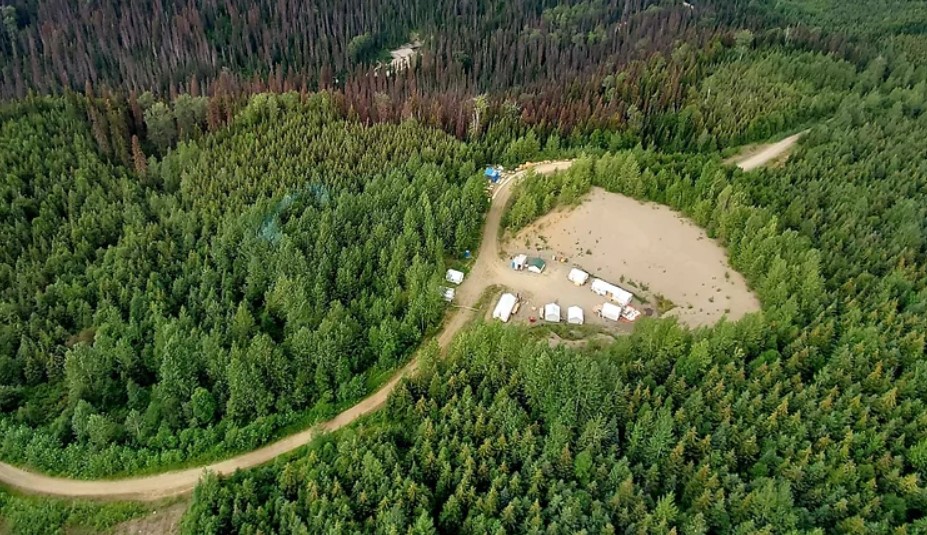
The Wicheeda camp near Prince George, B.C. Credit: Defense Metals
Resource-conversion drilling at Defense Metals’ (TSXV: DEFN) Wicheeda rare earths project in British Columbia has returned results as strong as 65 metres grading about 3% total rare earth oxides (TREO).
That interval, in hole WI26-96, from 61 metres depth included 20.3 metres at 6.1% TREO, the company reported Monday. Another highlight, in hole WI26-93, cut across the southern margin of the Wicheeda deposit, and returned 184 metres grading 1.7% TREO from 91.6 metres depth, including 57 metres at 2.5% TREO.
"We're exceptionally pleased that all eleven drill holes reported in today's news release intersected significant widths of high to moderate grade rare earth element mineralization within the pit confines defined by the 2025 preliminary feasibility study and are expected to contribute positively to a resource classification uplift,” Defense Metals’ Vice-President of Projects Robin Jones said.
Advanced project
The results bolster Wicheeda’s potential as one of Canada’s more advanced and accessible projects pursuing rare earths, essential for their use in permanent magnets, defence applications and clean energy technologies. Unlike several of the country’s largest rare earth deposits, which are in remote northern regions, Wicheeda is road-accessible and sits near power, rail and gas infrastructure, about 80 km northeast of Prince George, B.C.
Discounted at 8%, Wicheeda has an after-tax net present value of $1 billion and a post-tax internal rate of return of 19%, with initial capital costs of $1.4 billion, according to a preliminary feasibility study released in February, 2025. It could produce 31,900 tonnes annually of TREO concentrates over a 15-year life, based on proven and probable reserves of 25.4 million tonnes grading 2.43% TREO for about 617,000 tonnes of TREO.
Additional noteworthy results from the 5,345-metre program were in hole WI26-100, which cut about 149 metres grading 1.55% TREO from near surface, including 85 metres at 2.4% TREO.
Hole WI26-102 returned 73.4 metres grading 2.6% TREO from about 6 metres depth, including 34.3 metres at 3.2% TREO.
$16M backing
Defense secured $16.7 million from private placements last October and November which it plans to use for metallurgical work and for starting a feasibility study. In March, it received conditional approval for up to $1.8 million from Natural Resources Canada’s Critical Minerals Infrastructure Fund.
A proposed $346.6 million Export Development Canada loan, announced last year, remains at the non-binding expression-of-interest stage.
Shares of Defense Metals fell about 3% to 15¢ apiece Monday morning in Toronto. That gave the company a market capitalization of about C$61.2 million. The stock has traded in a 12-month range of 11¢ to 43¢.